Reading time: 5 minutes
Accordingly, he decided right from the start to sell his products via weekly markets. His philosophy was: “My customers don’t need to come to me. I go to them.”
Although the Eisele family moved their production facilities to new, larger premises in Ostrach's Fabrikweg in 1984, and expanded the site further with an extension in 2000, his son, Thomas Eisele, has stuck to the market tradition and continues to focus exclusively on mobile sales.
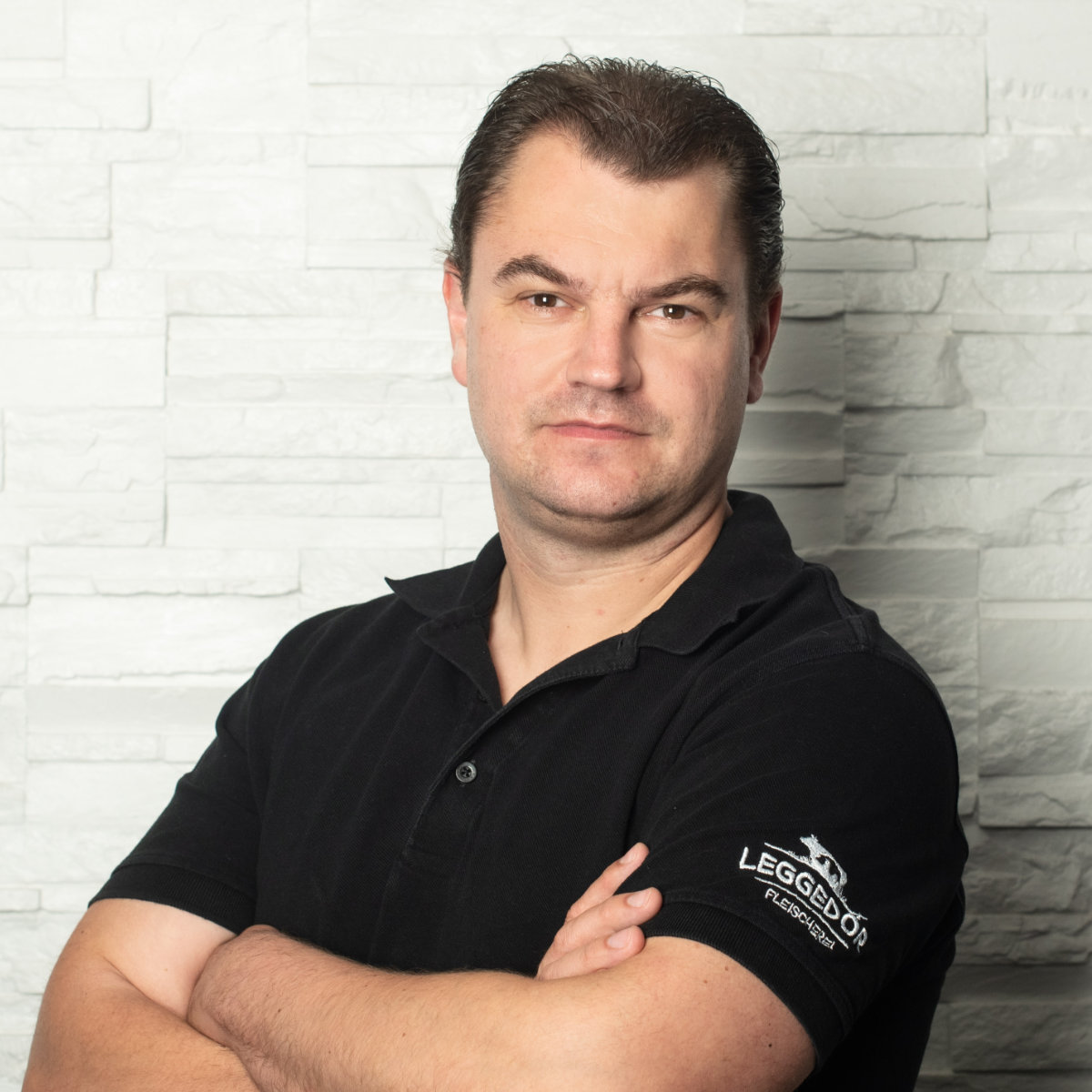
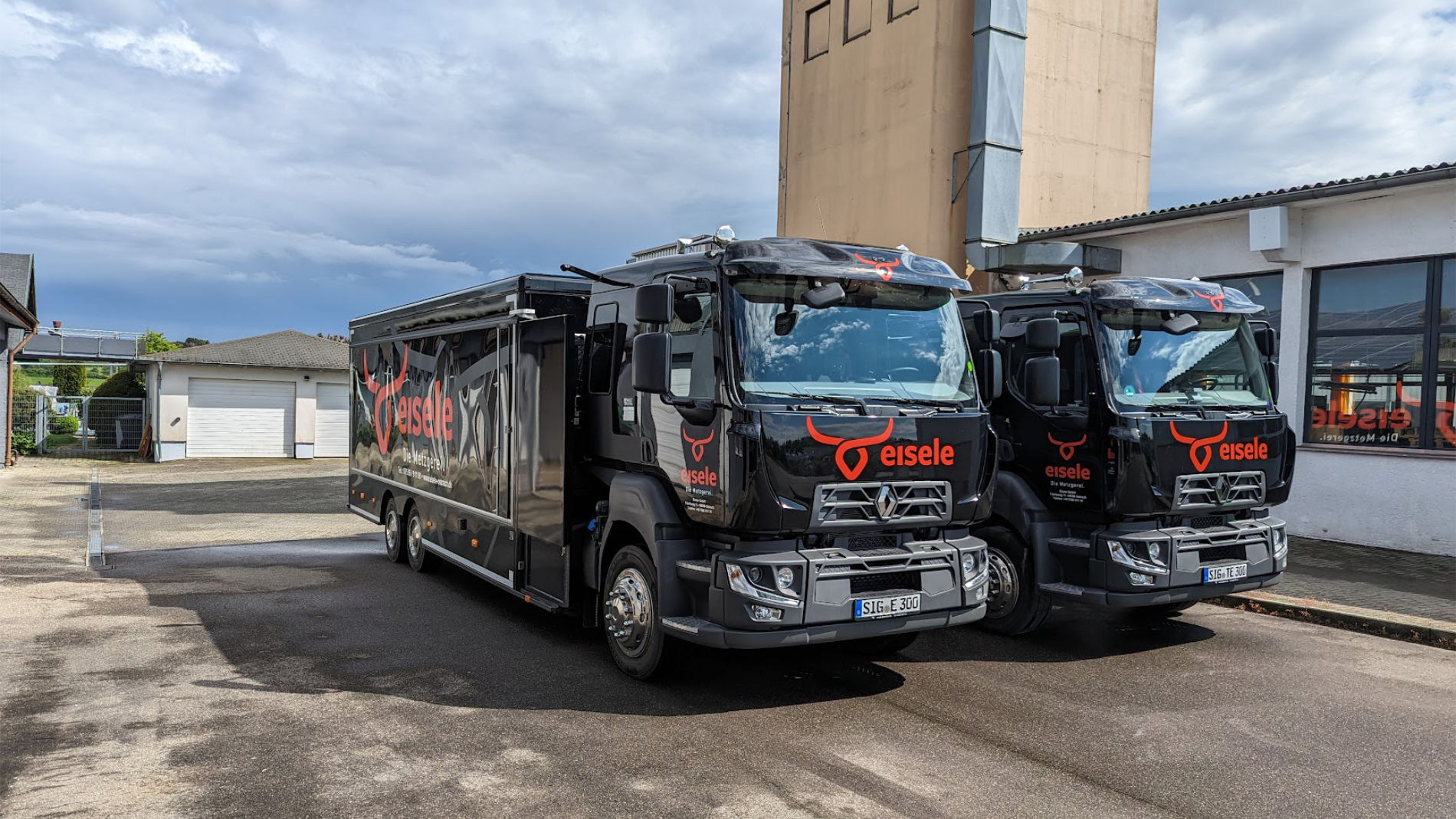
The 51-year-old qualified as a master butcher in Augsburg in 1997 and joined the family butcher’s business seven years later. Today, he sells his products at several weekly markets in the region – in medium-sized towns such as Markdorf, Friedrichshafen, Immenstaad, Albstadt-Tailfingen, Weingarten and Ravensburg – all the way down to Lake Constance. These markets are served by two 16-tonne lorries. And if, for example, they have to serve three instead of two markets before public holidays or when market days are rescheduled, there is a trailer for the third one.
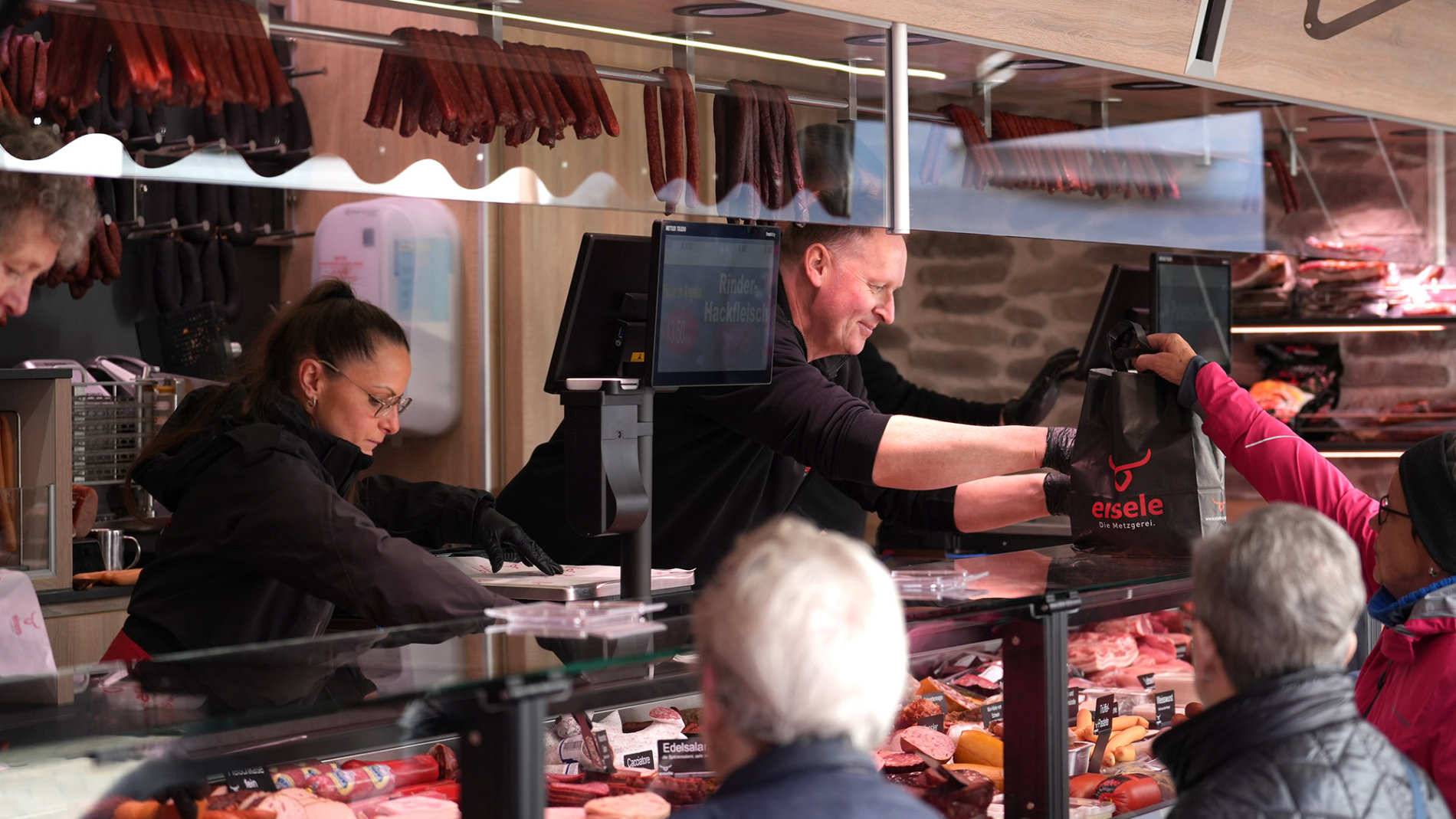
“We’re perfectly positioned with our weekly market business,” says Thomas Eisele, citing shopping habits as one reason. “If people can only find you in a town or at a location once a week, the average spend is usually higher than in brick-and-mortar shops.” Naturally, customers visit the latter outlets more frequently, but they only buy the quantities of meat, sausages or ready-made salads needed for their daily requirements. By contrast, weekly market customers stock up – because they know that it will be a whole week before their favourite butcher is there again.
Resurgence at weekly markets
Thomas Eisele is currently experiencing a resurgence in trade at weekly markets – a pleasant surprise because, just a few years ago, he was worried that mobile sales were losing their appeal as his predominantly older customers had begun to stay away. “Nowadays, lots of younger people come to our market stall and they include, for example, mothers with children who appreciate both the pleasant market atmosphere and the high quality and freshness of our produce,” he explains, estimating that no less than 90 percent of his customers are regulars.
He calls the holidaymakers who come to Lake Constance every year “semi-regulars” who look forward to shopping at Eisele’s stalls at the markets in the vicinity of Lake Constance during their vacation.
Eisele's lorries have been visiting most towns every week for at least 50 years. Competition in the meat and sausage sector is fierce everywhere and, depending on the size of the market, four to five butchers can be found vying for business there. Eisele takes a relaxed view of the competition and refers to his competitors as fellow traders.
Eisele has to reapply for all of his weekly market stalls every year and the fees charged for the stalls vary considerably from one local authority to another. While tourist-oriented towns in the Lake Constance region promote their markets as a flagship attraction for holidaymakers, other local authorities prefer to make a tidy profit from the market trade. “Hence, the market fees range from 150 to 3,000 euros a year, with electricity charged separately,” says Eisele who is to be found serving in one of the market stalls several times a week. This approach is well received by customers, especially when they learn of his training as a meat sommelier. He showcases his expertise both on his T-shirts and on his name badges. “The additional training has been very beneficial,” he says. “I’m still in touch with the other course participants and we regularly discuss the latest trends and cuts of meat, as well as exchange ideas and opinions.”
’Power traps‘ for energy self-sufficiency
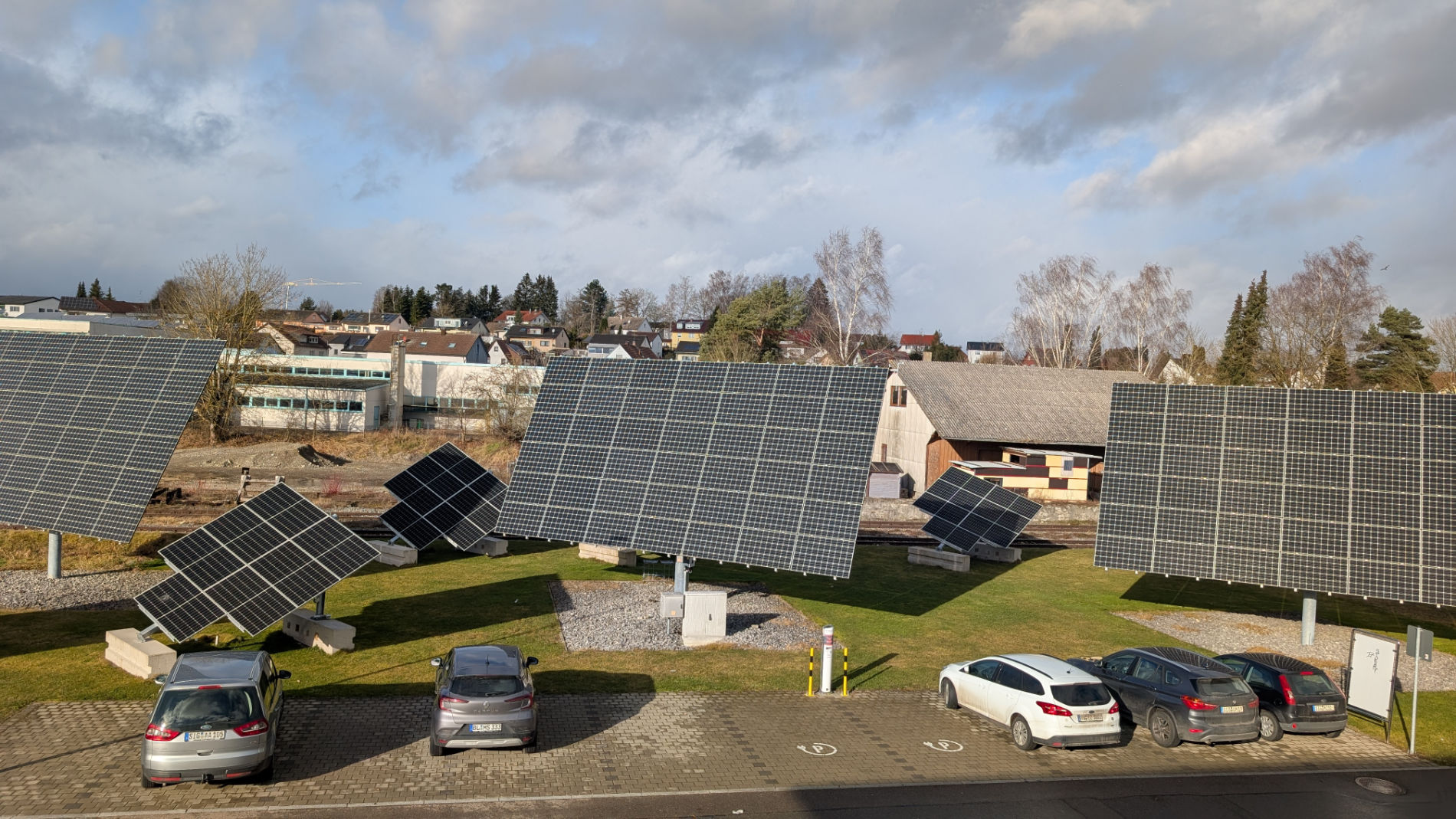
Thomas Eisele doesn’t just sell his products and advise customers when he’s away at the weekly markets. He also controls his energy system in Ostrach fully automatically via a tablet or smartphone. The system comprises three photovoltaic installations with a total capacity of 115 kilowatt-peak (kWp)1, a cogeneration plant, an electric car for his own use, and several charging stations, some of which can also be used by the public. His interest in renewable energy and storage goes back many years because his refrigerated market vehicles consume large amounts of electricity. Additionally, the cutters used in sausage production, the refrigeration systems, combination steamers and other machinery and equipment are real energy guzzlers that drive up operating costs.
To curb rising costs, Eisele has been relying on solar power since 2015 and has had photovoltaic systems installed at its premises as ‘power traps’. The solar panels rotate and automatically align themselves with the sun’s position. The energy generated is fed into an energy storage system via a Pacadu2 controller, resulting in a self-sufficiency rate of 70 percent within the first few years. Then, when the solar panels began producing far more electricity than the first storage system could accommodate, Eisele installed a second one. With both systems, he can boast a capacity of 214 kilowatt-hours (kWh) and an output of 90 kilowatts (kW). “My car’s battery is connected to the system during charging and discharging, thereby further increasing the storage capacity to a total of 304 kilowatt-hours,” he adds.
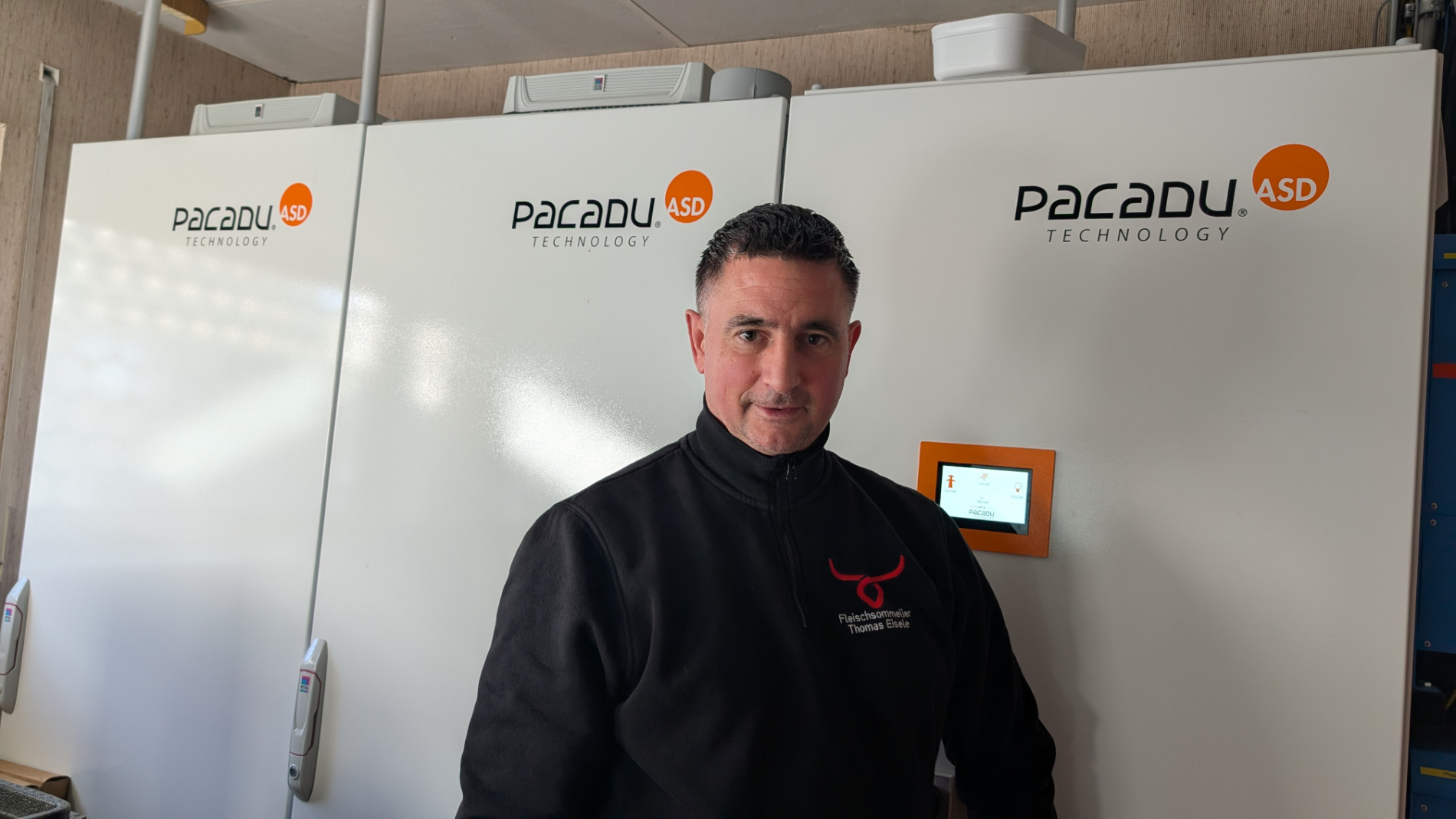
Eisele values his cogeneration plant as a practical buffer. It kicks in immediately when the storage system hit its limits due to insufficient sunlight or very high peak loads and can supply 160 kilovolt-amperes (kVA) of power, which enables the business to carry on operating should there be a power cut. “We are now 75 percent self-sufficient and I only purchase the remaining 25 percent of energy if and when necessary.” In other words, the connection to the public grid is just a last resort – an emergency power supply – that is activated by the control system. For the time being, he is satisfied with the system and its performance: “Of course, we could do even better. But, at the moment, we’re simply happy with every day the sun shines.”
Sources
1 Kilowattpeak (kWp): Unit of measurement for the electrical power that a photovoltaic system can generate under ideal conditions.
2 Pacadu: The Pacadu energy-storage system uses a smart-charging system based on parallel-connected lithium iron phosphate (LiFePO₄) batteries, also known as LFP batteries, a type of lithium-ion battery that uses iron phosphate as the positive electrode.
People in the Butchery Trade

The people who work with meat and sell meat products are just as diverse as the tasks involved in the butchery trade.
Our global series profiles creative and skilled individuals, from traditional butchers to those who have switched careers.