
Reading time: 5 minutes
Despite difficult general conditions, 2025 was a positive year for German manufacturers of food processing and packaging machinery. According to figures from the German Federal Statistical Office, the companies recorded growth of 4.9 percent in 2025, reaching a new production record of almost EUR 17 billion in Germany. However, growth in this third-largest mechanical engineering subsector was largely driven by the high order backlog with which companies started in the year 2025.
Production at record level – Packaging machinery shows dynamic growth
More than half of total production value is accounted for by packaging machinery. Manufacturers increased their output by 8.9 percent to nearly EUR 9 billion. About one third of packaging machinery is supplied to the beverage industry.
In the heterogeneous food processing machinery sector, production growth varied widely. Manufacturers of meat processing machinery increased production by 4.1 percent to almost EUR 1.3 billion in 2025. In the highly specialised confectionery machinery segment, production rose by 10 percent to EUR 386 million. Manufacturers of bakery machinery fell 1.6 percent short of the previous year’s level, reaching a production value of EUR 670 million. Production of beverage manufacturing machinery declined by 5 percent to EUR 503 million.
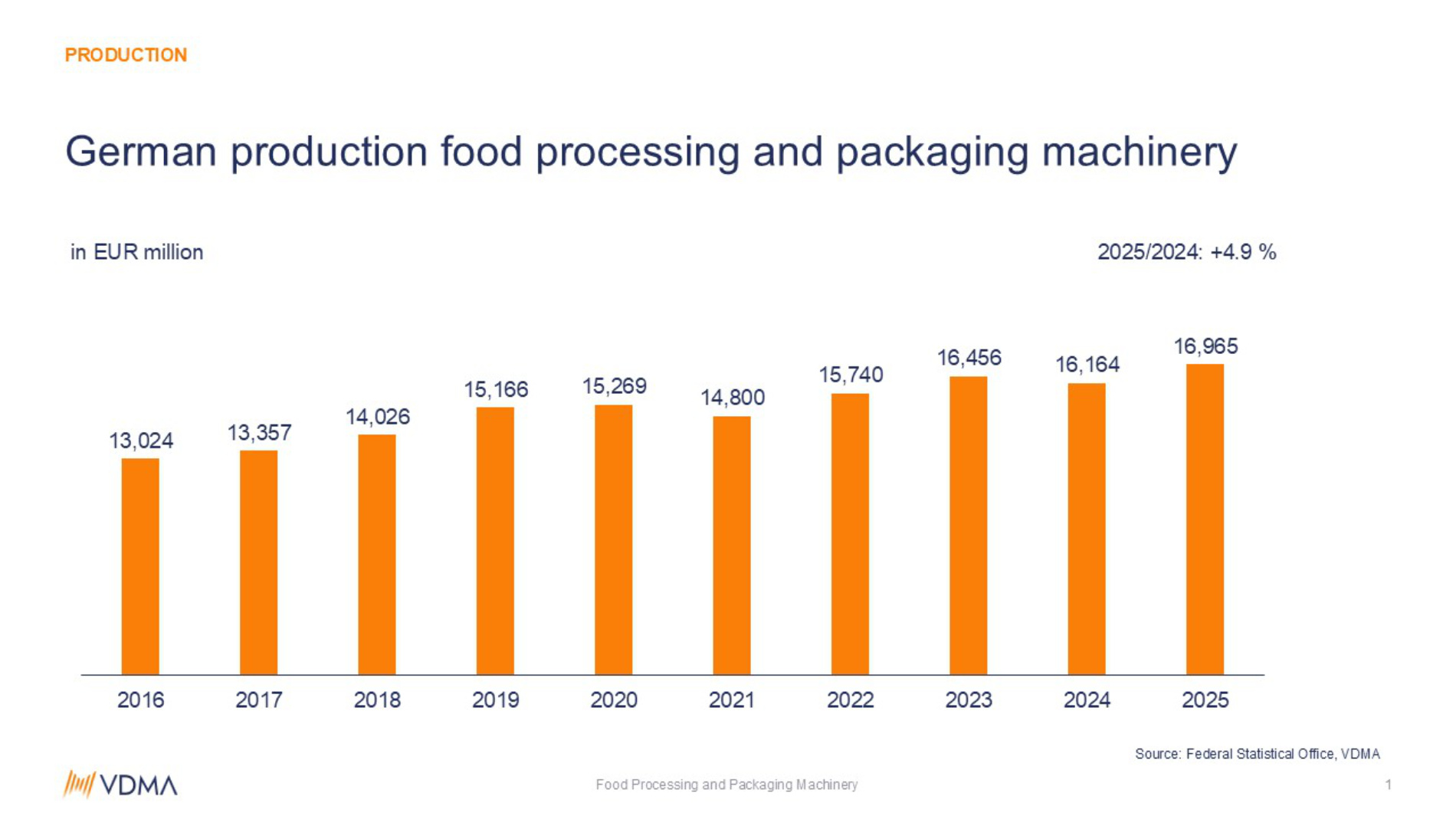
By contrast, incoming orders in the food processing and packaging machinery sector ended 2025 slightly below the previous year’s level. In the first quarter of 2026, incoming orders remained below expectations. Geopolitical crises, economic weakness in many key sales markets, US tariff policy, the ongoing war in Ukraine and recent developments in Iran are creating uncertainty and delaying investment decisions.
Nevertheless, given strong global growth in the food, beverage and pharmaceutical industries, the VDMA Food Processing and Packaging Machinery Association continues to view the sector’s growth prospects positively.
German exports show very different developments across subsectors
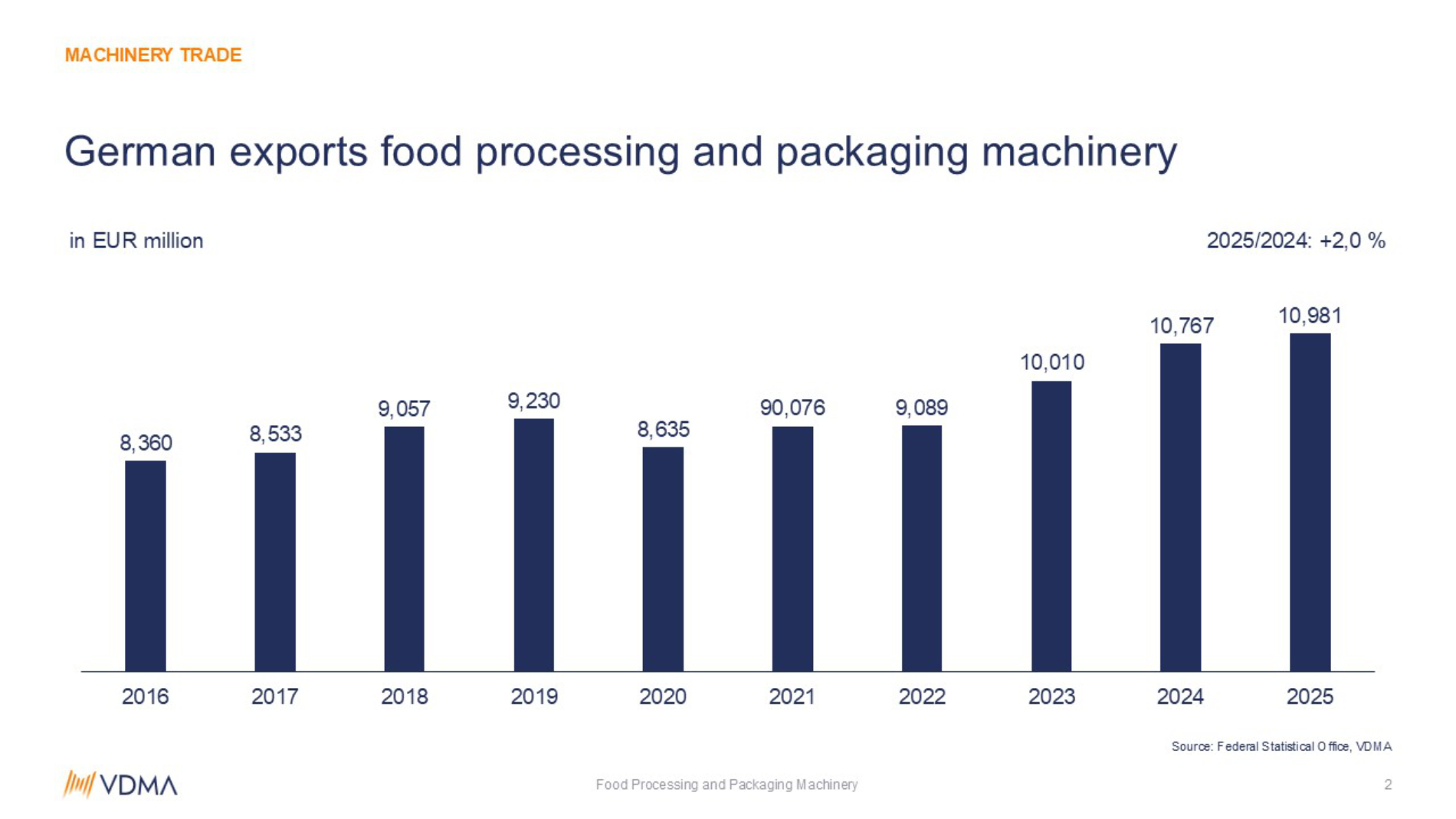
In 2025, foreign deliveries by the entire food processing and packaging machinery sector rose by 2 percent to around EUR 11 billion. Almost 70 percent of exports were attributable to packaging machinery, including beverage filling machines. Exports of packaging machinery rose by 5.9 percent to just under EUR 7.5 billion. Exports of meat processing machinery increased by 2 percent to EUR 706 million. Export deliveries of bakery machinery fell 7 percent short of the exceptionally high previous-year figure, reaching EUR 439 million. Manufacturers of confectionery machinery also fell 2 percent short of the 2024 record, exporting machinery worth EUR 401 million1.
In the beverage machinery sector, only brewery equipment is explicitly recorded in foreign trade statistics. Exports fell by 39 percent to EUR 143 million, reflecting the global decline in beer consumption. This trend appears to be becoming entrenched, resulting in significantly lower investment.
Europe remains by far the most important regional market for the food processing and packaging machinery sector. Exports to the EU-27 increased by 4.2 percent, while deliveries to the rest of Europe declined by 3.3 percent. Overall, 48 percent of German exports went to European countries, including 35 percent to the EU-27.
After Europe, North America is the most important sales region for German manufacturers of food processing and packaging machinery, with the United States by far the largest individual market. In 2025, machinery worth almost EUR 1.8 billion was exported to the US, accounting for 16 percent of total exports. Germany is the most important supplier of food processing and packaging machinery to the US, ahead of Italy, Canada and China.
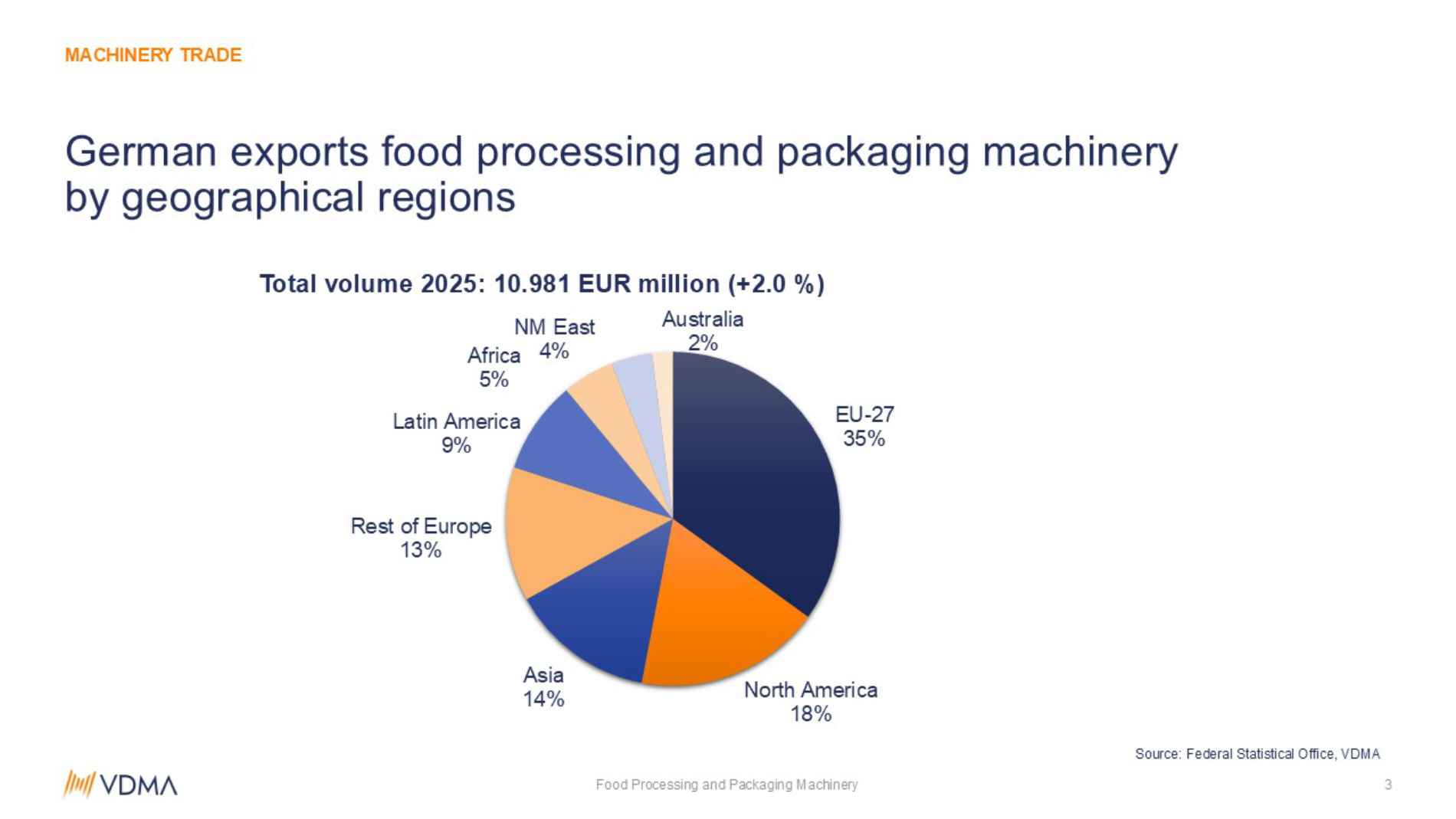
Asia remains one of the most important sales regions, accounting for 14 percent of exports. China, formerly the second most important market for the sector, has fallen to fifth place. From 2023 onwards, exports to the People’s Republic of China declined sharply and fell by a further 8 percent in 2025 to EUR 409 million. Slower economic growth in China and the government’s “Made in China” policy favour locally manufactured machinery, increasing localisation pressure for European manufacturers.
By contrast, other Asian countries such as India, South Korea, Thailand and Indonesia have made substantial investments over the past three years.
Overall foreign demand remained high in 2025, with strong momentum and double-digit growth rates from individual markets, including Mexico, Brazil, Egypt, Algeria, Saudi Arabia and South Africa. With an average export share of 84 percent, machinery manufacturers are highly internationalised, enabling them to offset regional demand fluctuations. In the most recent VDMA business climate survey (April 2026), regional business prospects for Africa, South and Central America and Asia were assessed positively for the next six months.
Global machinery trade increases – Europe supplies two thirds of all machines
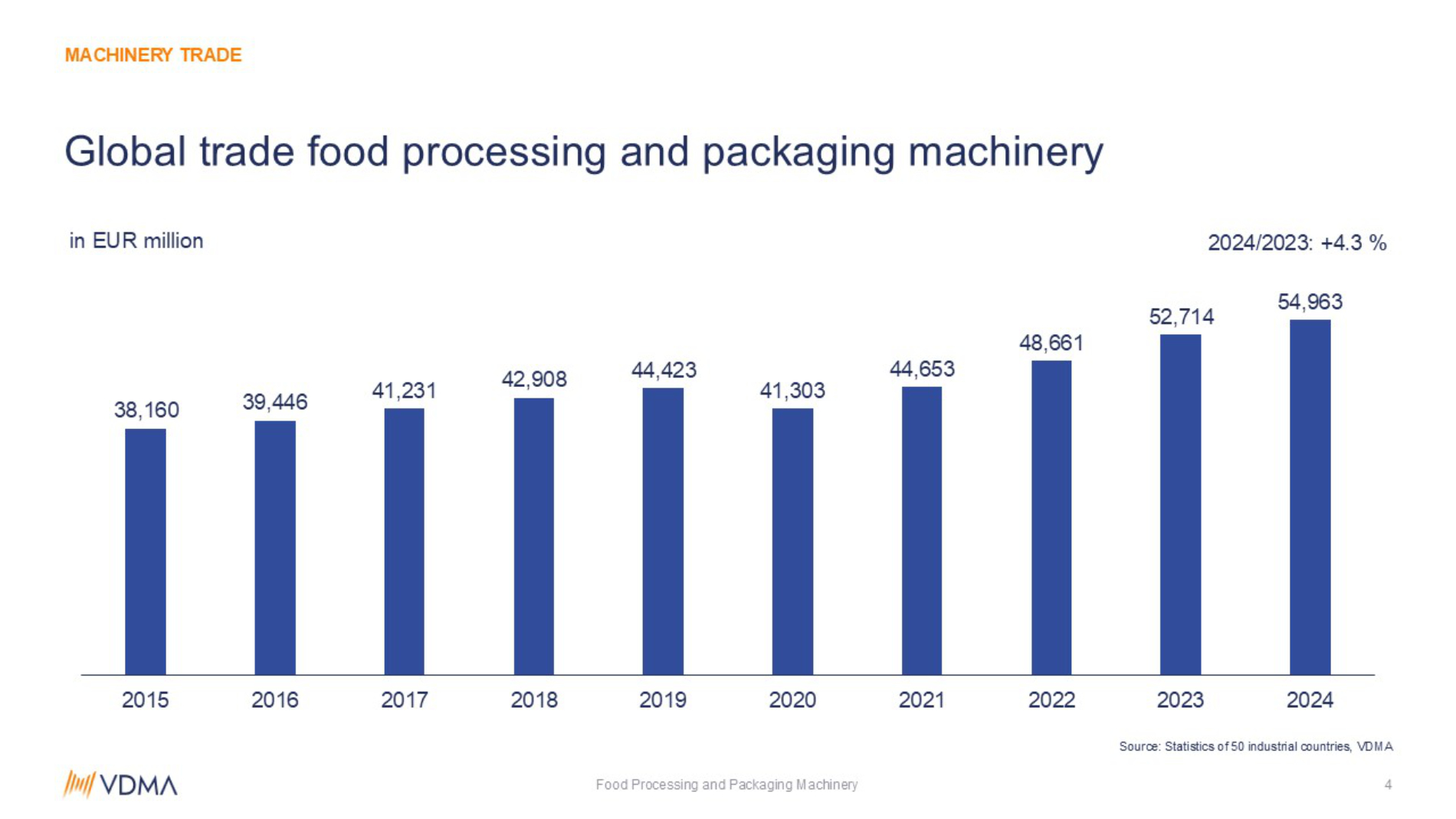
Not only are German exports growing, the global foreign trade volume of food processing and packaging machinery has also been rising steadily for many years, reaching a provisional peak of almost EUR 55 billion in 2024. The data is based on exports from more than 50 industrial countries. For 2025, the association expects further global trade growth of 4 to 5 percent.
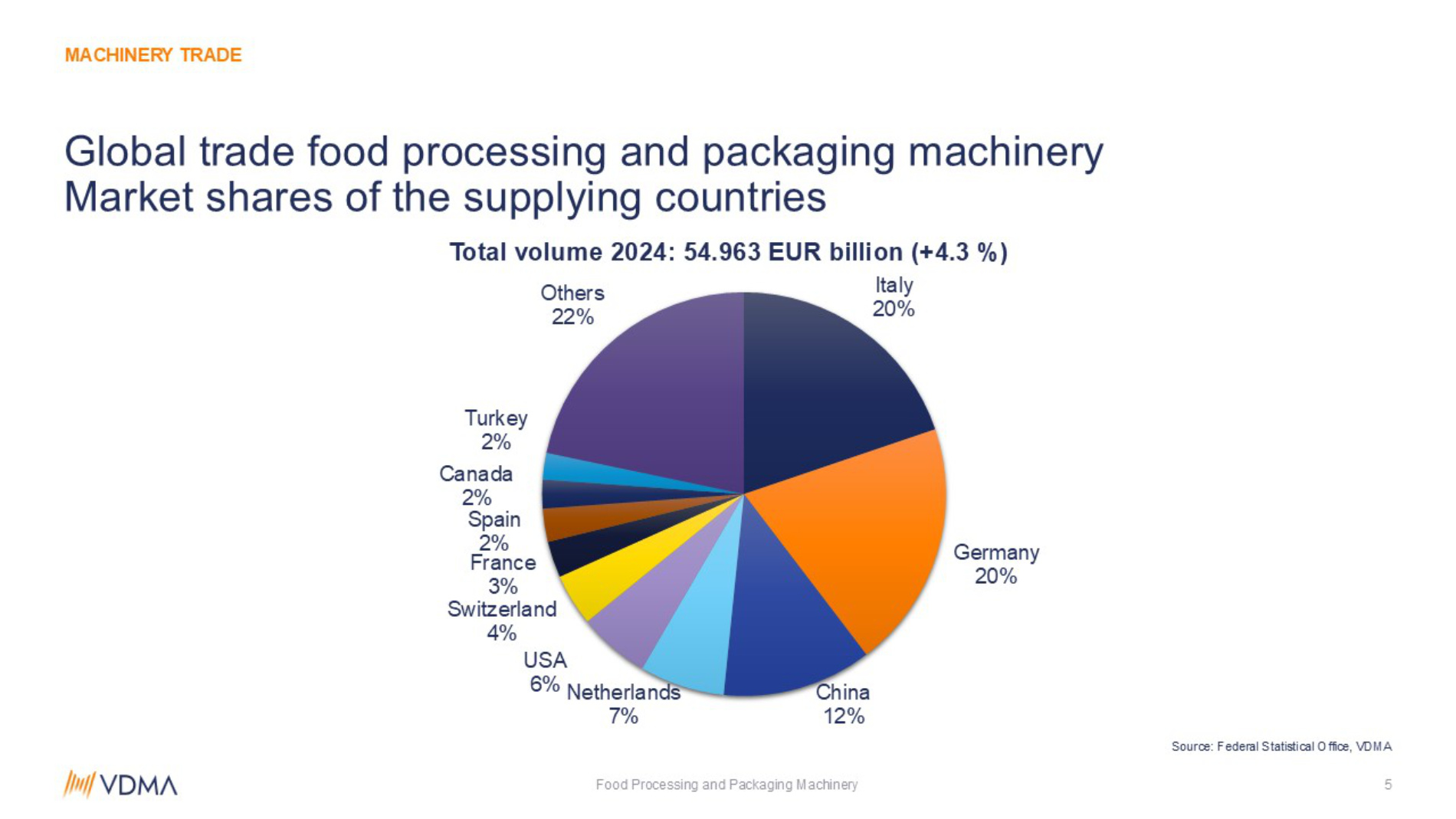
Two thirds of all food processing and packaging machinery exported worldwide originate from the EU-27 (as of 2024). Due to its high degree of specialisation, performance and innovative strength, the food processing and packaging machinery sector is the most successful export segment of European mechanical engineering. Germany and Italy jointly lead the field, each accounting for around 20 percent of global machinery trade.
At subsector level (2024), German manufacturers command even higher market shares: 25 percent of globally traded packaging machinery, 30 percent of confectionery machinery and 27 percent of meat processing machinery.
Positive outlook despite challenges
The global packaging and processing industry is one of the most dynamic growth sectors. Manufacturers of food processing and packaging machinery benefit from rising global sales of packaged food. Their machinery plays a key role in ensuring the safe supply of a growing world population with a wide range of food, beverages and pharmaceutical products.
Market research institute Euromonitor International forecasts that global sales of packaged food will increase from 872 million tonnes in 2024 to 968 million tonnes in 2029 – an increase of 11 percent. Almost one third of total consumption in 2024 was accounted for by Asia. Demand is also expected to grow at above-average rates in Asia and the Middle East/Africa.
Against this background and based on the VDMA’s regular business climate surveys, companies in the food processing and packaging machinery sector are more optimistic about economic conditions and revenue expectations than many other subsectors facing structural changes in their customer industries.
Based on the high production level in 2025, the VDMA Food Processing and Packaging Machinery Association forecasts moderate growth of around 3 percent for 2026.
1 The fact that exports of confectionery machinery exceed production is due to incomplete reporting to the Federal Statistical Office. The VDMA estimates the missing production volume at around EUR 100 million.
Image Header: Canva