Reading time: 4 minutes
Australia, Finland, India: Even as a teenager, Victoria Blüm from Lampertheim in the southwest of Germany had a strong desire to travel and was very interested in foreign countries and cultures. Today, the 32-year-old can boast a degree in geography with a minor in politics, as well as courses in food policy and sports history, reflecting her wide range of interests.
Fascinated by her high-school classes, Victoria Blüm decided to study geography in Heidelberg. She spent a semester abroad in the UK, wrote her bachelor's dissertation in collaboration with the German Butchers' Association in 2016, and then worked as a volunteer at the Summer Olympics in Rio de Janeiro. After returning from South America, she moved to the Welsh city of Cardiff, where she enrolled in a course on food policy entitled ‘Food Politics and Sustainability’. While researching her master's thesis, Blüm met the late Karl-Ludwig Schweisfurth, an entrepreneur who had built up the Herta meat factory in Herten into one of Europe's largest producers between the fifties and eighties and was later regarded as a pioneer of organic farming and food craftsmanship. Meeting Schweisfurth inspired the inquisitive Victoria to pursue an apprenticeship as a butcher. Unsurprisingly, her parents, Paul Blüm and Anette Hübner-Blüm, who run a seventh-generation butcher's shop, were delighted with this decision.
From butchery apprenticeship to award-winning Bratwurst
She signed her articles of apprenticeship with Simsseer Weidefleisch, a small cooperative in the Bavarian town of Stephanskirchen, which still slaughtered animals and processed the fresh meat itself. In 2019, Blüm received her journeyman's certificate – with straight A's, as the best in her guild – and was awarded the Bavarian State Prize. But that’s not all: while still an apprentice, she took a correspondence course in sports history at the University of Leicester "just for fun, a laugh and out of great interest".
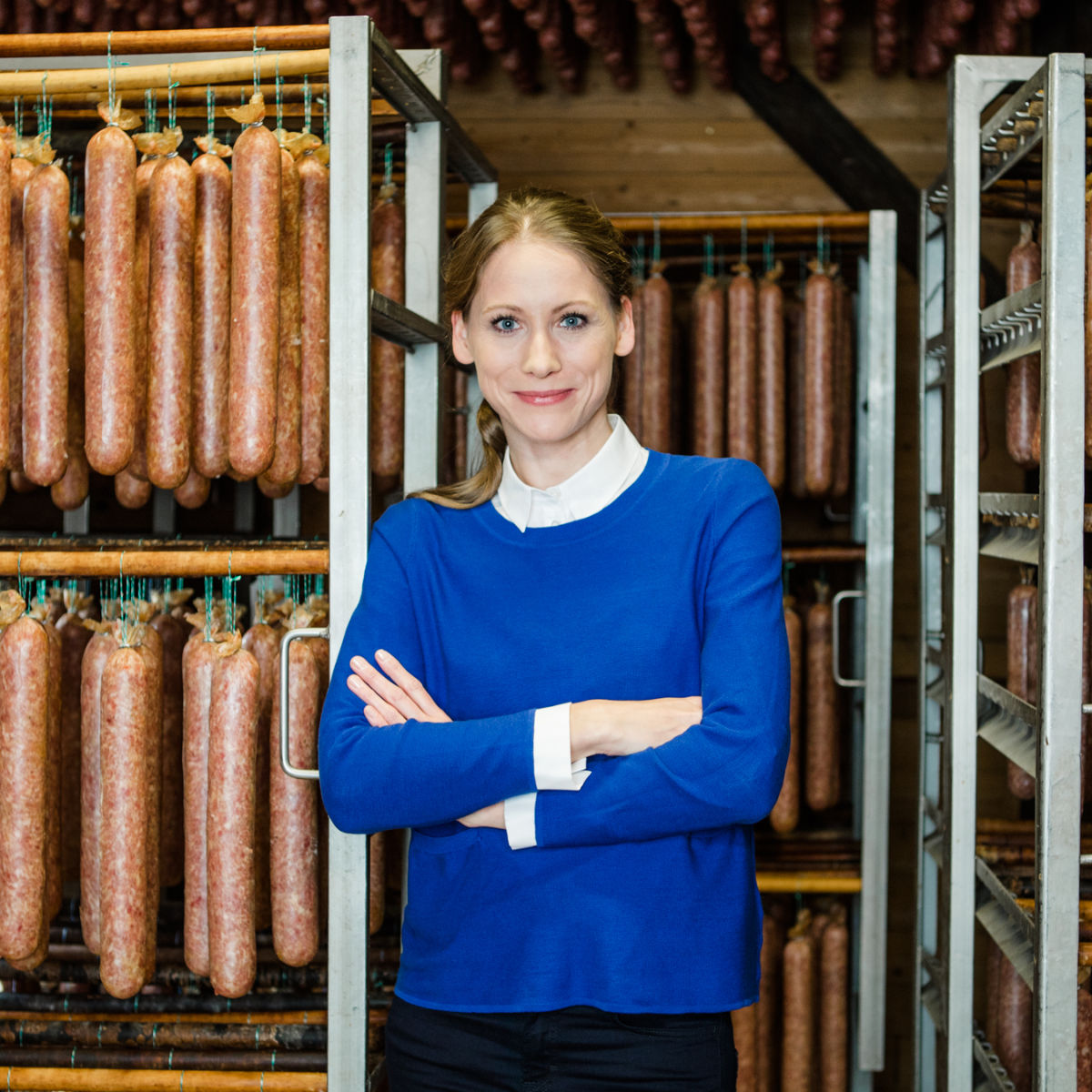
In the summer of 2019, she returned to her parents' business as a newly qualified butcher and, just two years later, qualified as a Master Butcher at a vocational-training school in Darmstadt-Weiterstadt. Blüm was very clear about not wanting to become a meat sommelier: "Everything I need to know about meat, I've either learnt on the job or read about." Instead, she prefers to indulge her creative streak making new kinds of sausage, especially different kinds of bratwurst. Whether it's mojito bratwurst with lime, rum, mint and cane sugar or a pumpkin recipe for Halloween, customers are always amazed at what's on offer at the counter. Only recently – just in time for the opening ceremony of the Winter Olympics in Italy – the young master butcher had the spontaneous idea of creating a spaghetti bolognese bratwurst.
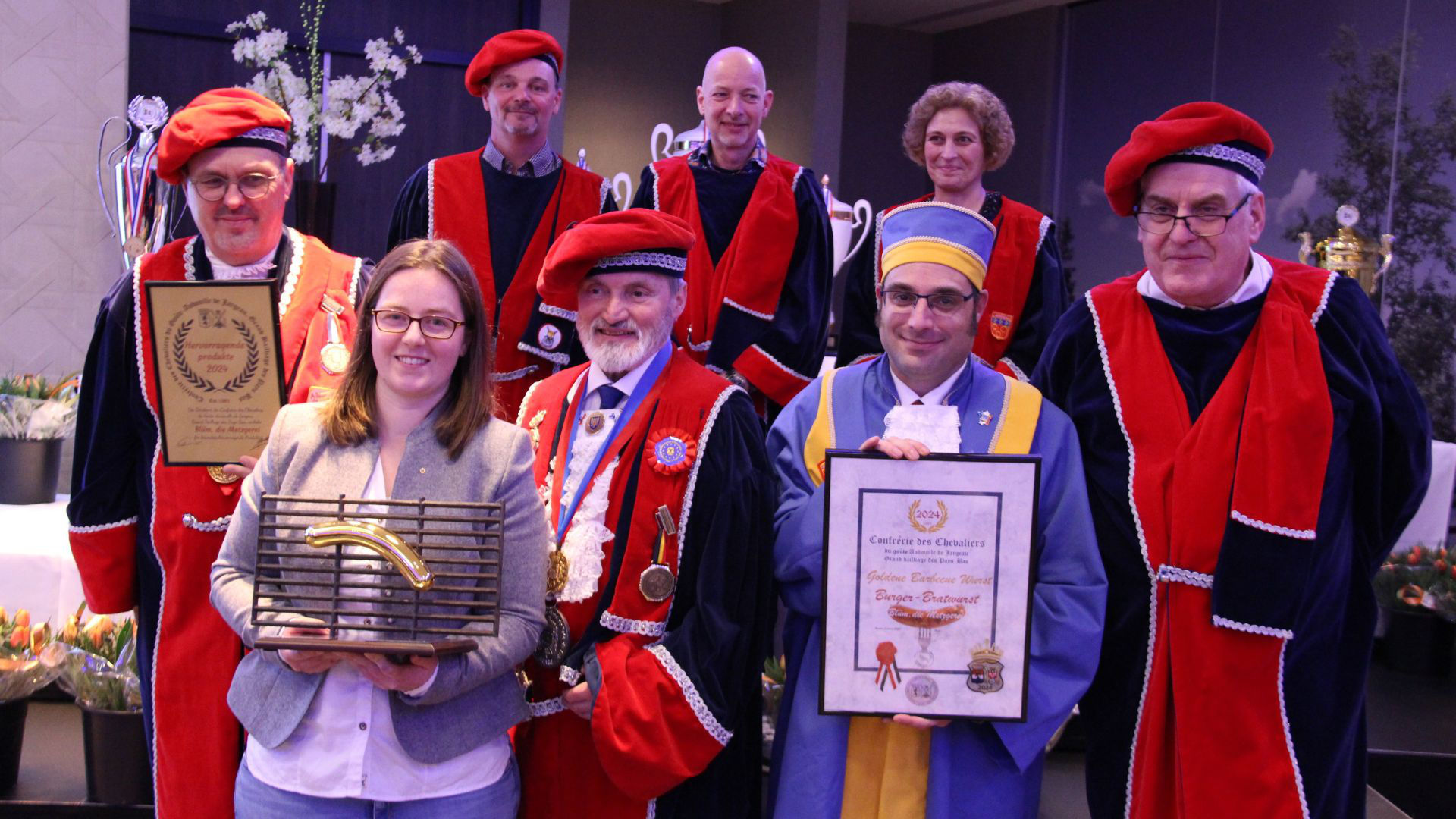
Her grandfather was a regular participant in sausage-making competitions, and his trophies filled the family basement to bursting point. Hence, it was no surprise that Victoria also wanted to put her skills to the test, and, in 2024, she entered six of her bratwurst creations for the European sausage competition organised by the Confrérie des Chevaliers du Goûte-Andouille de Jargeau in Heerlen, the Netherlands. There, she beat 170 colleagues from six different countries and took home the ‘Golden Bratwurst’ trophy for her burger sausage made from beef, cheese, gherkins, onions and ketchup.
After a report in the local press about her success, a real media hype began. "It was an absolutely crazy year," recalls Blüm. "I had to coordinate requests from TV and radio stations, give interviews and travel to Baden-Baden for a television recording." Indeed, it felt like Blüm's sausage kitchen was only making bratwurst, and the online shop exploded. Now, after the big rush, everything has settled back down to a good but normal level.
Read more articles from “People from the butchers’ trade”Traditional craftsmanship and new perspectives
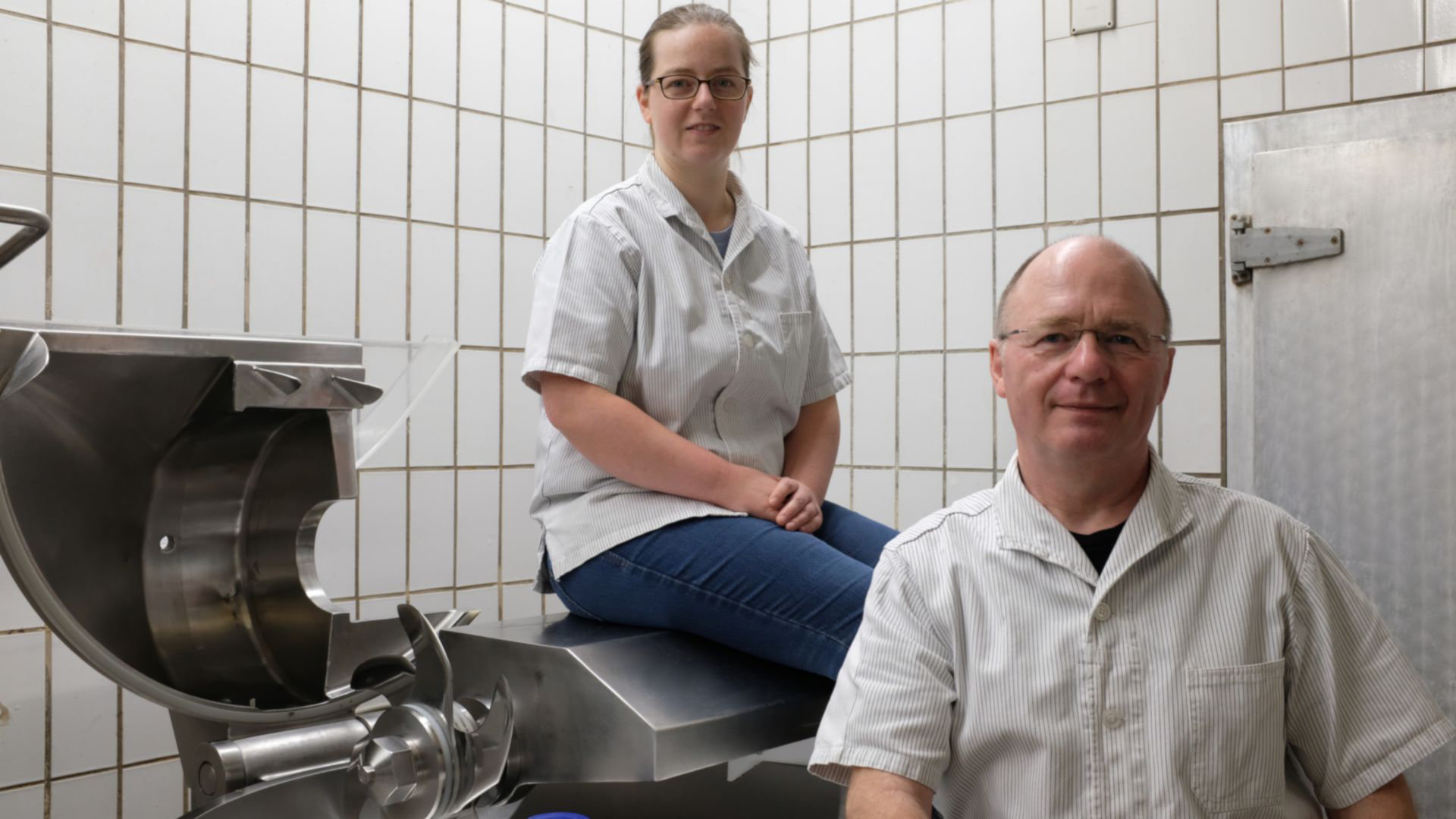
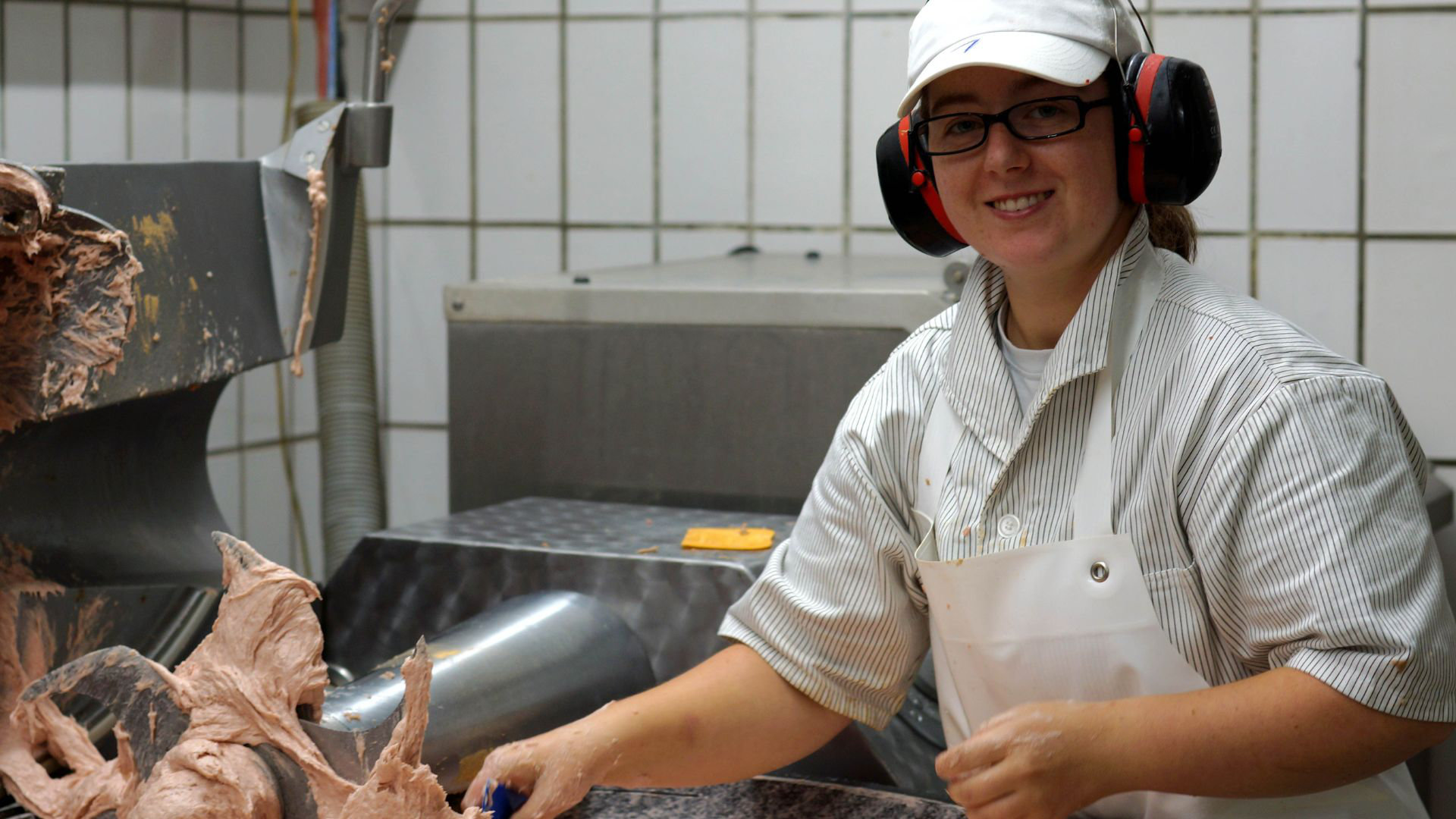
Competitive success shows Victoria is on the right track: “The great thing about my job is that I can look around, come up with new ideas and experiment,” she says enthusiastically. One thing she likes about the artisan trade is that it’s “small and manageable" and not bound by rigid structures, which she suspects is the case in many larger companies. She is fascinated by the fact that almost everything is still done manually in Lampertheim: “While many of our colleagues use machines to make their burger patties, we form them by hand." Every piece of beef goulash is also hand-cut, and every roulade is placed in the tin by hand.
Victoria Blüm does not consider plant-based products to be meat substitutes but rather raw materials, just like meat, fish or eggs. Although customers do not specifically ask for meat-free products, she offers a canned vegan red lentil dhal and a vegan pumpkin soup in which the cream has been replaced by coconut milk. Neither of these are the biggest sellers in the range but they do quite well. As Blüm says, "A recent study suggests that the vegan and vegetarian trend is stagnating. However, I think more people will become flexitarians in the future."
Blüm considers that the painful structural changes of recent years are nearly over. "The remaining butcher's shops are doing well," she says. Although artisan butchers cannot compete with their competitors in the retail food sector on price, they can certainly do so in terms of quality. However, this means more than product quality for Victoria: “Competent advice is becoming an increasingly important subject for us with regard to nutritional questions, allergens, intolerances and inadequate cooking skills.” And this is why the Blüms employ only specialist staff behind the counter – people who cook at home themselves and are able to offer useful tips.
Victoria Blüm's long-term career plans are still open. Asked whether she will take over her parents' butcher's shop when her father retires next year, she responds diplomatically saying, “That's a good question,” before adding tongue-in-cheek: "If an exciting job offer from the private sector comes my way, anything is possible." To be prepared for all eventualities, she has already enrolled in a degree programme in ‘Food Management and Technology’ at SRH Fernhochschule - The Mobile University1. In addition to specialist knowledge, she also wants to gain economic and technological expertise related to the industry. As a third career option, Victoria mentions specialising in ‘pâté en croûte’2 and, to gain the necessary expertise, she completed internships with charcuterie experts in London and Lyon last year. “I mainly make these pâtés in autumn and during the Christmas season. In Germany, however, only lovers of French cuisine are familiar with these wonderful products.”
Sources
1 The Heidelberg Rehabilitation Foundation (SRH) is a private foundation under civil law (SdbR) based in Heidelberg. It is the holding company of a group of subsidiaries operating in the health, education and social services sectors. The SRH group also includes private universities.
2 Pâté en croûte is a French pâté speciality made from puff or shortcrust pastry and filled with veal, pork, poultry or venison.

People in the Butchery Trade

The people who work with meat and sell meat products are just as diverse as the tasks involved in the butchery trade.
Our global series profiles creative and skilled individuals, from traditional butchers to those who have switched careers.