
Reading time: 7 minutes
According to the European Fat Processors and Renderers Association (EFPRA), up to half of every animal raised for food production is not intended for human consumption: hides, bones, blood, fatty tissue and offal, which arise as animal by-products. The association's member companies collect 18 million tonnes of animal by-products every year in Europe and the United Kingdom, and process them mainly into feed, fertilisers and fuels.1
| Side stream | Recovered ingredients | Examples of food applications |
|---|---|---|
| Blood | Blood plasma, haemoglobin | Meat products, protein ingredients |
| Skin & rind | Collagen, gelatine | Confectionery, desserts, food supplements |
| Bones | Gelatine, minerals | Gelatine, food ingredients |
| Tendons & cartilage | Collagen peptides | Functional foods, protein products |
| Adipose tissue | Animal fats | Bakery products, margarine, flavourings |
| Meat trimmings | Meat proteins | Sausages, processed meat products |
According to the European Fat Processors and Renderers Association (EFPRA), up to half of every animal raised for food production is not intended for human consumption: hides, bones, blood, fatty tissue and offal, which arise as animal by-products. The association's member companies collect 18 million tonnes of animal by-products every year in Europe and the United Kingdom, and process them mainly into feed, fertilisers and fuels.1
No pan-European statistics exist on the return of these materials to food production. The route is discussed under the heading of upcycling; in technical terms it can be defined more precisely. A life cycle assessment study commissioned by the Swiss Federal Office for the Environment distinguishes two directions, following a systematic approach developed by Beretta and Hellweg:
Valorisation denotes the processing of a co-product-material that inevitably arises alongside the meat at slaughter – into food,
Recovery its processing into products that are not intended for human consumption.2 Biogas falls under recovery, gelatine under valorisation.
Which of these two routes remains open is decided earlier than the process technology would suggest.
The moment of classification
For whether a stream remains fit for food use depends not on the subsequent processing, but on the status it is assigned at the moment of slaughter.
Regulation (EC) No 1069/2009 divides animal by-products into three categories according to health risk.3 Category 3 carries the lowest risk and covers, among other things, material from animals that were judged fit for human consumption at slaughter. Only this material is eligible for a return to food production. EFPRA describes this category as material that is fit for human consumption at the time of slaughter.1 What is decisive, therefore, is a point in time, not a condition.
If a stream is declared for feed use, or is not collected separately and chilled, it leaves the food chain. The Regulation makes no provision for a later return, irrespective of the actual condition of the material.
How far this decision lies from technical feasibility is shown by an example from the Swiss study: offal is fit for consumption and requires no elaborate processing. Because demand is low, it goes mainly for export or is classified as Category 3 slaughter waste, according to the study.2 The process would be available. The demand is not.
Meat from bones
If the decision falls in favour of the food chain, recovery begins where the least processing is required.
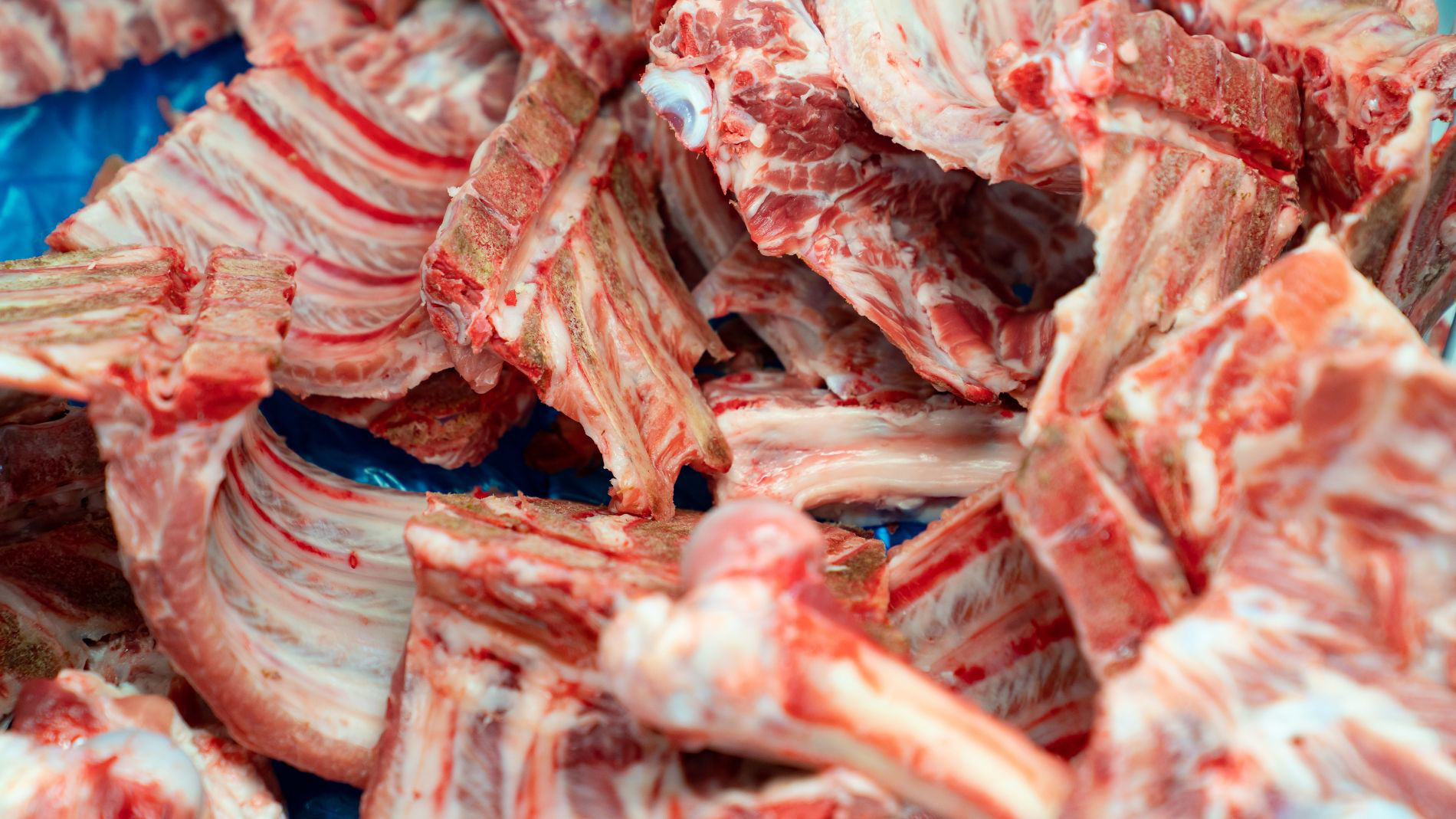
At the lowest level, muscle tissue is recovered that remains attached to the bone after deboning. The equipment manufacturer BAADER describes its refiner process as a gentle separation of soft from hard constituents: the soft fractions pass out through perforated plates, while the bones, according to the manufacturer, are neither crushed nor pulverised.4 Jos Bongers, Area Sales Manager BeNeLux and DACH, puts it this way: “This efficiently harvests the meat remaining on the bone while largely preserving the natural meat structure.”5 Visually, the product resembles minced meat rather than the fine paste that results when residual meat is pressed off the bone under high pressure.
For the legal classification, however, this visual difference is immaterial. In 2014 the Court of Justice of the European Union ruled in Case C-453/13 that such material must be classified as mechanically separated meat as soon as the process alters the muscle fibre structure more than occurs at cut surfaces – regardless of whether the bone structure remains intact. The judgment rules out classification as a meat preparation.6 For cattle, sheep and goats the process is excluded in any case: the Regulation on transmissible spongiform encephalopathies, a group of diseases of the central nervous system, prohibits the production of mechanically separated meat from their bones.7 For all other species, the product must be labelled as mechanically separated meat with the species stated.
That does not make the material worthless: if the process does not alter the bone structure and the calcium content is close to that of minced meat, the product may – subject to the corresponding microbiological evidence – be used in meat preparations that are heated before consumption, and in meat products. For material from other processes, only heat-treated meat products are eligible.8
It is therefore not the technology alone that determines the value of the material, but the legal classification that follows it. At the next level, the room for manoeuvre narrows further.
Learn more on circularity in food here: Going round in circles yet?
Using blood fractions – plasma and haemoglobin
There, the stream is no longer recovered but broken down into its constituents − in the case of blood, into plasma and haemoglobin. The window for this is narrow.
In legal terms, blood counts as meat: Regulation (EC) No 853/2004 explicitly names blood among the edible parts of slaughter animals.9 In practice, the further route is decided within a short space of time: collection takes place directly at the slaughter line under food hygiene conditions, with immediate stabilisation and chilling.
If this window is missed, the blood is physically unchanged – but in legal terms no longer a food. This decision is irreversible: once material has been classified as an animal by-product, it may not return to the food chain.
The blood is then separated by centrifugation into liquid plasma and the cellular constituents containing the haemoglobin; both fractions are spray-dried.
The product range of the Italian manufacturer Haripro shows how differently the fractions can be used. The company offers plasma proteins with 70 and 80 per cent protein content; they are water-soluble, have a high immunoglobulin content according to company information, and serve the meat products industry as a functional protein. Two products are derived from the cellular fraction: a dark red, readily soluble haemoglobin powder marketed as a colourant for the meat industry, and a white protein powder obtained by hydrolysis that is suitable as a natural flavour carrier.10
KU Leuven has investigated the functionality of plasma in a cooked emulsified sausage model. If phosphate is omitted without replacement, the cooking loss rises from 0.6 to 5.7 per cent. An addition of two per cent blood plasma reduces it to 0.9 per cent; statistically, there is thus no difference from the phosphate-containing reference.11
With haemoglobin, a circle closes: the side stream returns as a colourant to the product it came from. Both plasma and haemoglobin are obtained solely by mechanically separating the blood, without chemical digestion.
From pork rind to gelatine
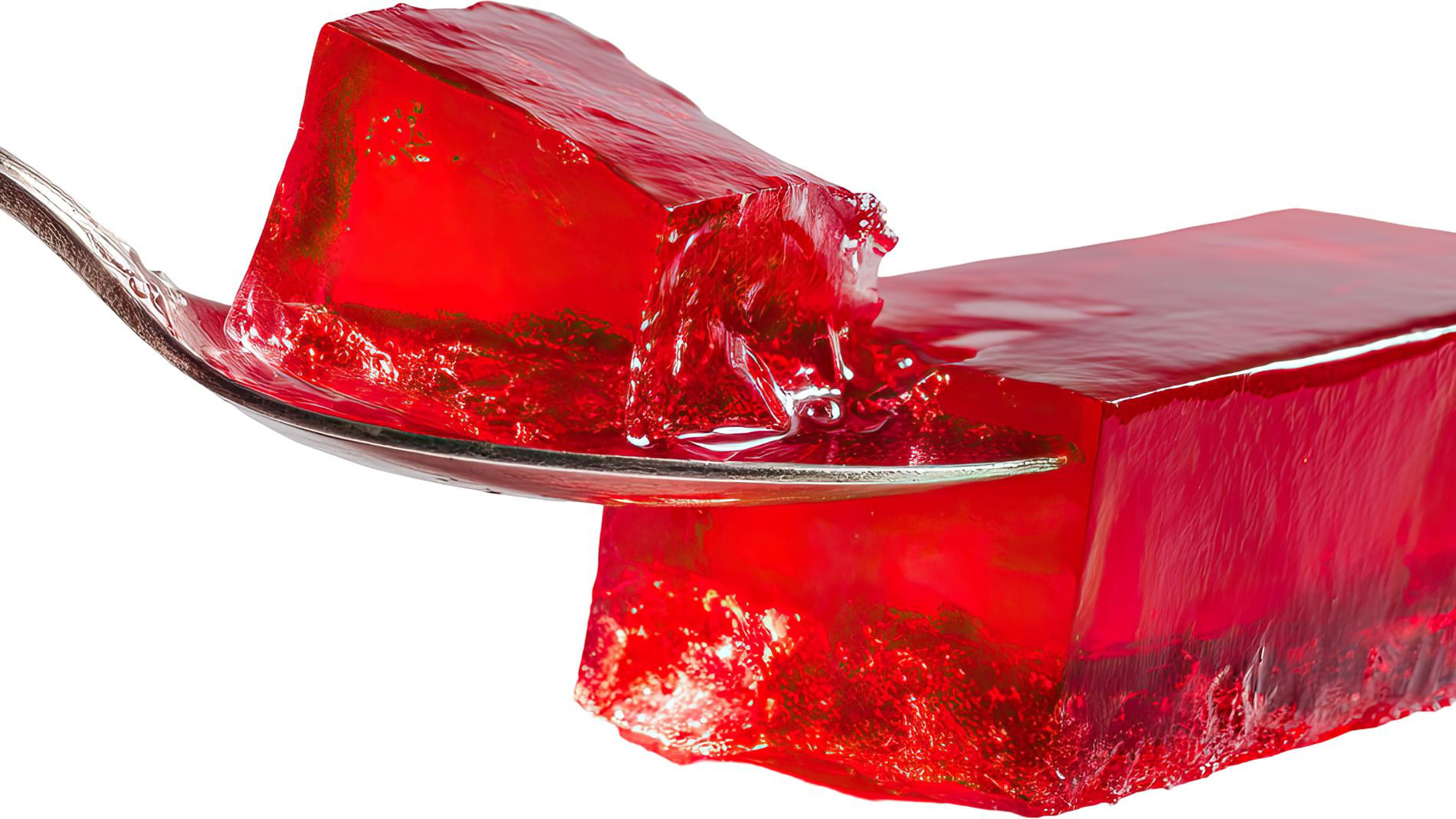
With collagen-containing material, mechanical separation is no longer sufficient. Collagen-containing material has to be chemically digested so that the collagen can be extracted − depending on the raw material and the quality, this takes anything from a day to several months.
According to Gelatine Manufacturers of Europe, around 80 per cent of the edible gelatine produced in Europe comes from pork rind and a further 15 per cent from split, the thin collagen-containing layer of bovine hide between the epidermis and the subcutaneous tissue. Pig and cattle bones together with fish account for 5 per cent.12
The pre-treatment depends on the starting material: bovine connective tissue is densely cross-linked and, according to the association, is treated with alkali for several weeks; for porcine connective tissue, one day of acid treatment is sufficient.
Extraction is carried out with hot drinking water, the temperature of which determines the later gel strength.12 At the manufacturer PB Leiner, the overall process takes up to six months for certain qualities.13
The two process routes yield ingredients with different fields of application. Every gelatine has a pH value at which it behaves in an electrically neutral way − the isoelectric point. For type A gelatine from acid digestion it lies between pH 8 and 9, for type B gelatine from alkaline digestion between pH 4.8 and 5.4.14 Above and below this value, gelatine behaves differently. The processor therefore selects the type to match the pH value of the formulation.
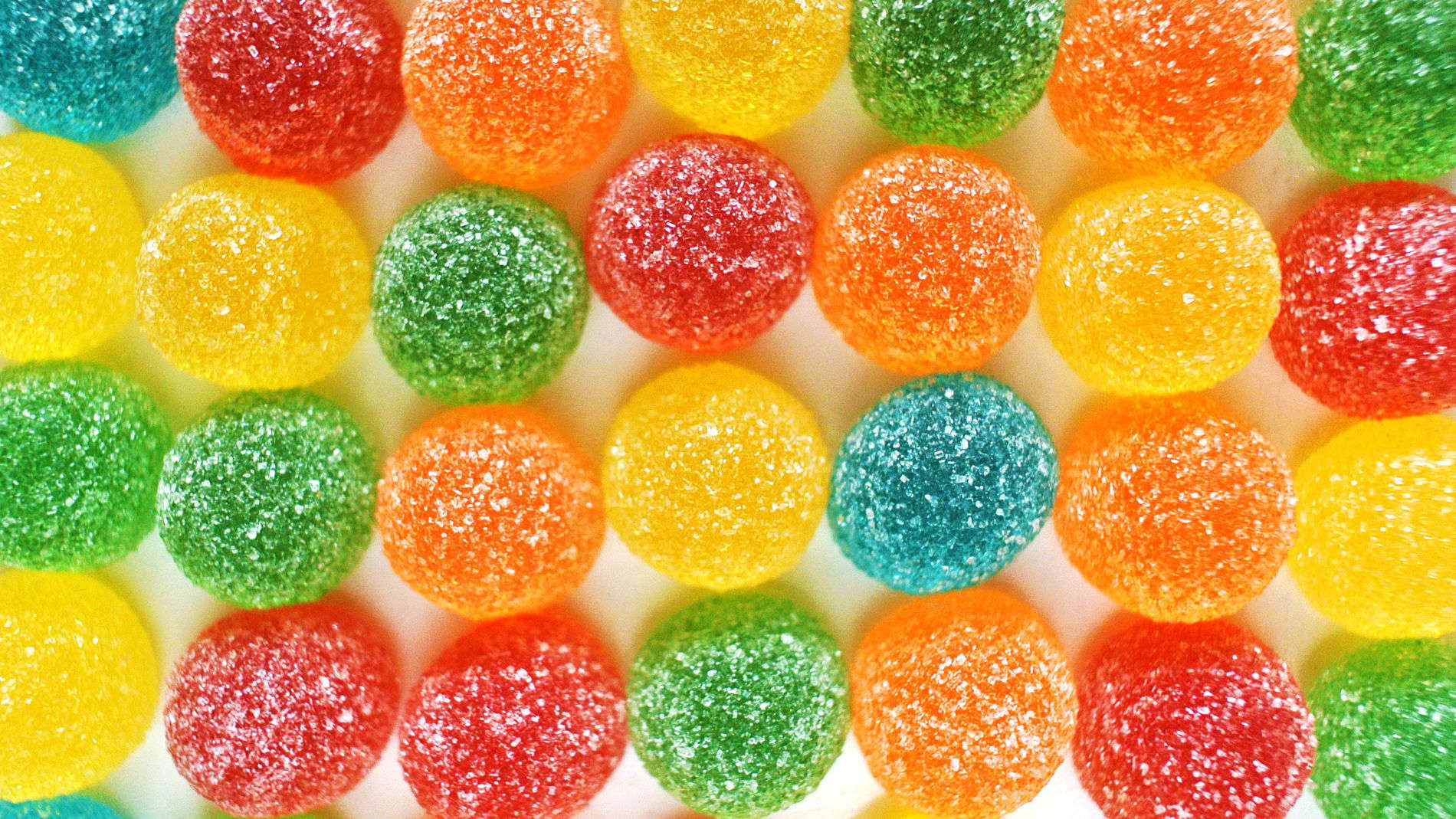
Three product stages are common: gelatine as a gelling and stabilising agent, for example in fruit gums and wine gums; collagen peptides from further enzymatic hydrolysis, which no longer gel but dissolve in cold water and remain almost neutral in taste – which is why they can be used in beverages, food supplements and cosmetics; Edible films and casings for meat and sausage products are also in use, such as those made by Devro – part of the SARIA Group since 2023.15
The residues of collagen production are used as well: from these, Gelita recovers, according to its own information, pure phosphates for fertilisers, proteins intended for aquaculture, and fats for renewable biofuels.16
The market for these products is consolidating. Darling Ingredients and the Tessenderlo Group are combining their collagen and gelatine businesses Rousselot and PB Leiner under the name Nextida17; the German Federal Cartel Office cleared the merger on 27 April 2026.18
Side-stream valorisation from the perspective of meat processing businesses
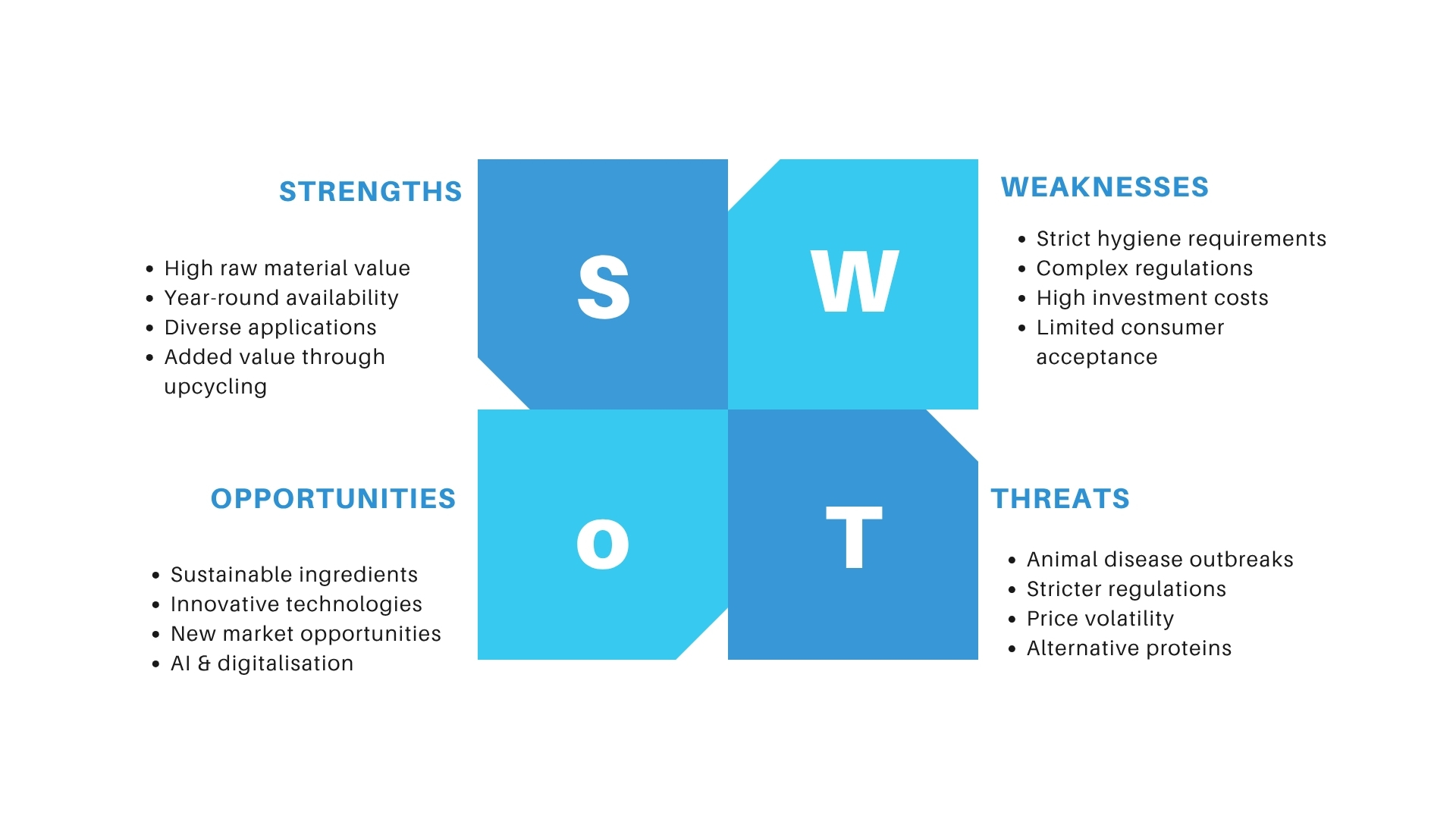
Strengths and weaknesses concern the business itself, opportunities and threats its environment, by Zhanar Sadyk
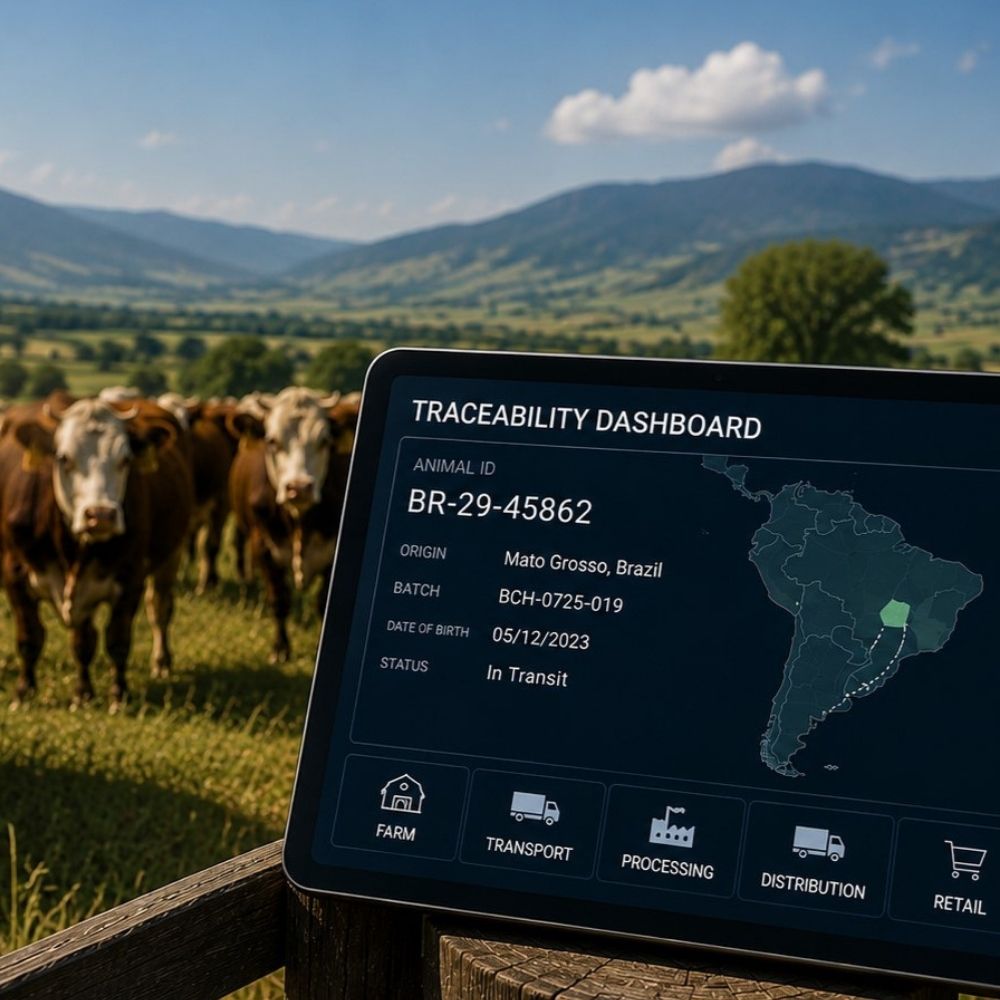
For meat processing companies, the question of using side streams begins not in processing but at slaughter. Separate collection, rapid chilling and full traceability determine which streams arise fit for food use. This is an irreversible decision: once material has left the food chain, it remains feed or a technical product.
Whether the effort pays off is decided by the application. Each fraction19 has its own function. Plasma protein binds water even after heating and thus reduces the use of phosphate in cooked emulsified sausage. Gelatine cannot do this; its gel melts during cooking. More processing therefore does not automatically bring a greater return. What is decisive is which substance a side stream replaces in the particular formulation – and whether the changeover pays off given a company's own size and volume of material.
The processes are ready. The bottleneck is not in the processing technology, but at the slaughter line.
Sources
1 Processing ABPs, European Fat Processors and Renderers Association (EFPRA), accessed 25.07.2026
2 Vergleichende Ökobilanzen: Valorisierung von Nebenströmen in der Lebensmittelindustrie, Maeder, S.; Vukasinovic, E.; Jamet, S.; Alig, M., Intep – Integrale Planung GmbH on behalf of the Swiss Federal Office for the Environment (FOEN), final report of 17.04.2025. Definitions after Beretta & Hellweg (2019), ch. 2.1; offal ch. 2.4; results tab. 43; discussion ch. 4.1; critical review in the annex. Accessed 27.07.2026 (only available in German language)
3 Regulation (EC) No 1069/2009 laying down health rules as regards animal by-products not intended for human consumption, European Parliament and Council, 21.10.2009, OJ L 300, 14.11.2009, p. 1. Accessed 28.07.2026
4 BAADERING Technology – The Gentle Method of Product Refinement, BAADER, company information Poultry Processing, doc. no. 0122 02 EN, baader.com, accessed 03.08.2026
5 Jos Bongers, Area Sales Manager BeNeLux and DACH, BAADER: written communication to the author, July 2026 (translated from German)
6 Judgment in Case C-453/13, The Queen on the application of Newby Foods Ltd v Food Standards Agency, Court of Justice of the European Union, 16.10.2014, accessed 01.08.2026
7 Regulation (EC) No 999/2001 laying down rules for the prevention, control and eradication of certain transmissible spongiform encephalopathies (TSE), European Parliament and Council, 22.05.2001, as amended. Accessed 29.07.2026. On the interpretation: Lebensmittel: Separatorenfleisch, Bavarian Health and Food Safety Authority (LGL), version of 02.10.2023, accessed 04.08.2026 (only available in German language)
8 Regulation (EC) No 853/2004 laying down specific hygiene rules for food of animal origin, Annex III Section V Chapter III points 3 and 4, accessed 30.07.2026
9 Regulation (EC) No 853/2004 laying down specific hygiene rules for food of animal origin, European Parliament and Council, 29.04.2004, OJ L 139, 30.04.2004, Annex I point 1.1; definition of mechanically separated meat ibid. Annex I point 1.14. Accessed 30.07.2026
10 Food ingredients of bovine origin and Food ingredients of porcine origin, Haripro S.p.A., accessed 31.07.2026
11 Phosphate Elimination in Emulsified Meat Products: Impact of Protein-Based Ingredients on Quality Characteristics, Goemaere, O.; Glorieux, S.; Govaert, M.; Steen, L.; Fraeye, I., Foods 10(4):882, 2021, doi 10.3390/foods10040882. Cooked sausage model, reference with 0.171 % P₂O₅, protein addition 2 g/100 g in each case; cooking loss per tab. 1. Funded 80 % by Flanders Food and the Flemish innovation agency, 20 % by the Flemish meat and ingredient industry; blood plasma supplied by Veos, gelatine by Rousselot. Accessed 02.08.2026
12 Manufacturing of gelatine, Gelatine Manufacturers of Europe (GME), page version of 31.01.2024, accessed 27.07.2026
13 PB Leiner, Tessenderlo Group, accessed 30.07.2026
14 Schrieber, R.; Gareis, H.: Gelatine Handbook. From Collagen to Gelatine. Weinheim: 2007
15 SARIA erweitert Portfolio mit der Übernahme von Devro, SARIA SE & Co. KG, press release of 14.04.2023, accessed 26.07.2026 (only available in German language)
16 Fats, Proteins, Minerals, GELITA AG, accessed 29.07.2026
17 Darling Ingredients and Tessenderlo Group sign definitive agreements to form new company, Darling Ingredients Inc., press release of 10.12.2025, accessed 28.07.2026
18 Darling Ingredients kann Kontrolle über PB Leiner erwerben, Bundeskartellamt, press release of 27.04.2026, accessed 03.08.2026 (only available in German language)
19 A fraction is a constituent obtained by separating blood or blood plasma – for example plasma, the cellular fraction or specific protein group.
Alle images: Canva