
Reading time: 10 minutes
Algae have long since found their way into the food industry, not just as a source of protein. Alginate, carrageenan and agar come from seaweed and have been standard ingredients for decades, used as thickening and gelling agents¹. The raw material is there, the supply chains are in place and the processes are well established.
At the same time, demand for alternative proteins is growing. According to the United Nations, the world’s population is expected to reach almost 9.8 billion by 2050. Climate change is seen as a risk to food systems, and limited arable land is weighing on yield expectations². Crop failures are adding to the price pressure on conventional protein sources³. Even so, algae still play hardly any role as a protein source in Europe. Fraunhofer IVV attributes this partly to limited processing solutions and partly to open questions about product safety and functional properties⁴.
What algae are and how they are produced
Algae are broadly divided into macroalgae and microalgae. Macroalgae are multicellular organisms that grow in the sea and are harvested or cultivated. Microalgae mostly consist of single cells and cannot be seen with the naked eye⁵. Scientifically, they are classified into brown, red, green and blue-green algae, among others⁶. The second edition of the algae list published by the German Federal Office of Consumer Protection and Food Safety (BVL) contains 75 entries, including 46 macroalgae and 27 microalgae⁶.
- Brown and red algae are exclusively macroalgae in the algae list, with 19 entries each⁶. Well-known foods are the red alga nori in sushi and the brown alga wakame in miso soup⁵.
- Green algae occur in both size classes: the list contains eight macroalgae and 19 microalgae of this group⁶. The microalgae include Chlorella, a spherical microalga about 2 to 10 micrometres in diameter with a cell nucleus⁷.
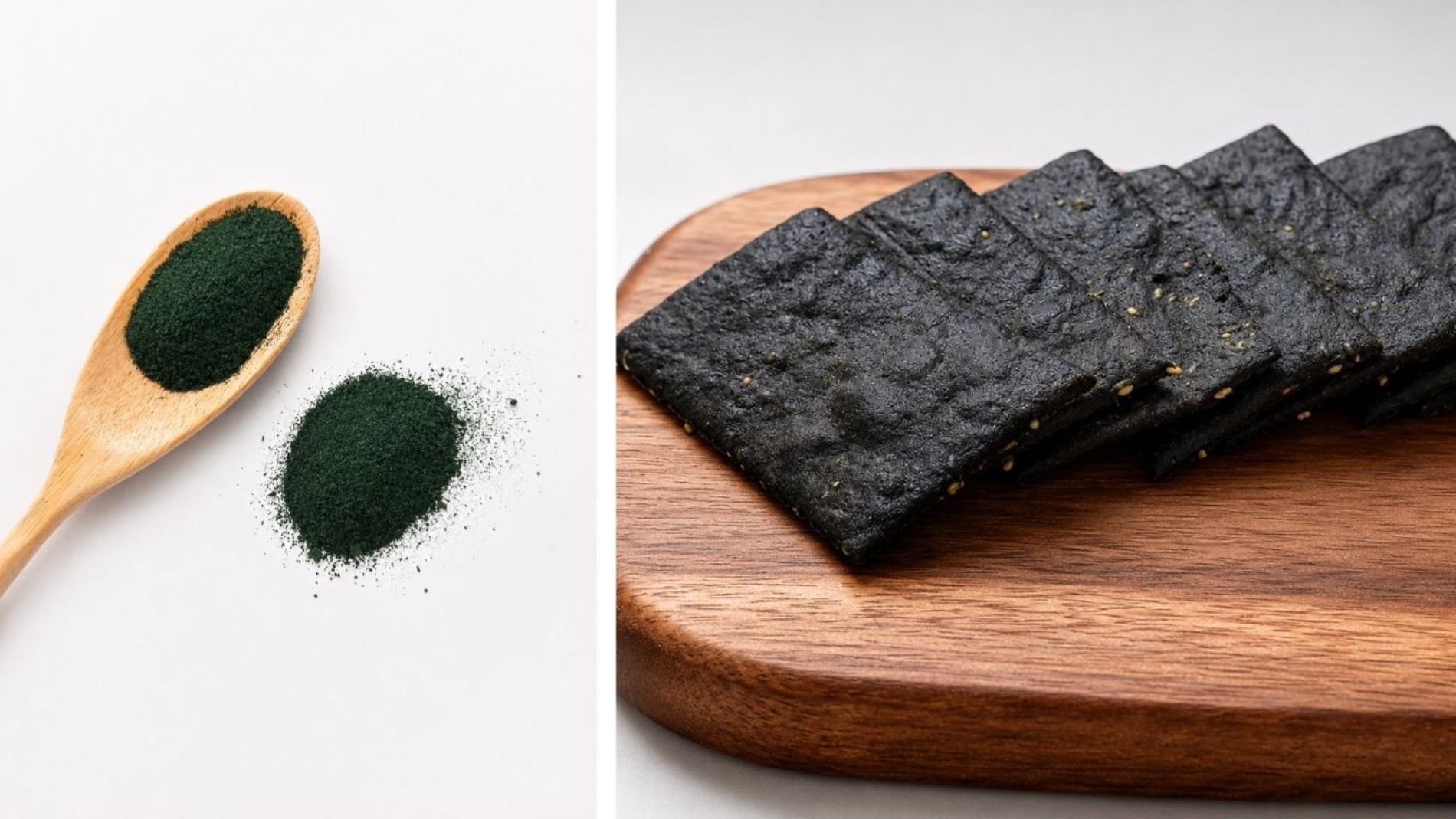
- Blue-green algae are exclusively microalgae in the algae list, with six entries⁶. They include Spirulina, which strictly speaking is not an alga but a cyanobacterium. Unlike Chlorella, it has no cell nucleus⁷. This difference in cell structure also matters later in processing.
For protein production, the focus is mainly on Spirulina and Chlorella.
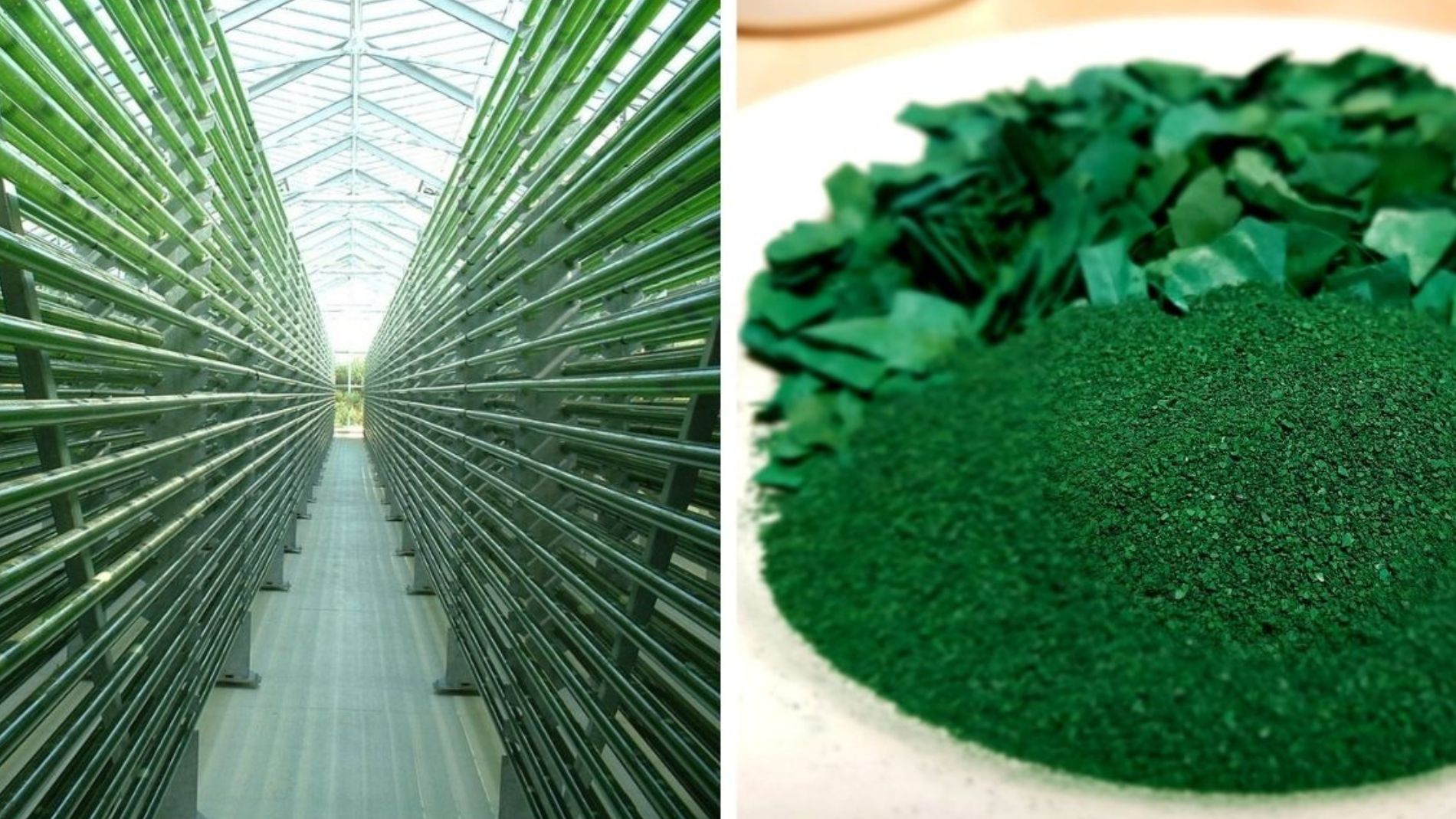
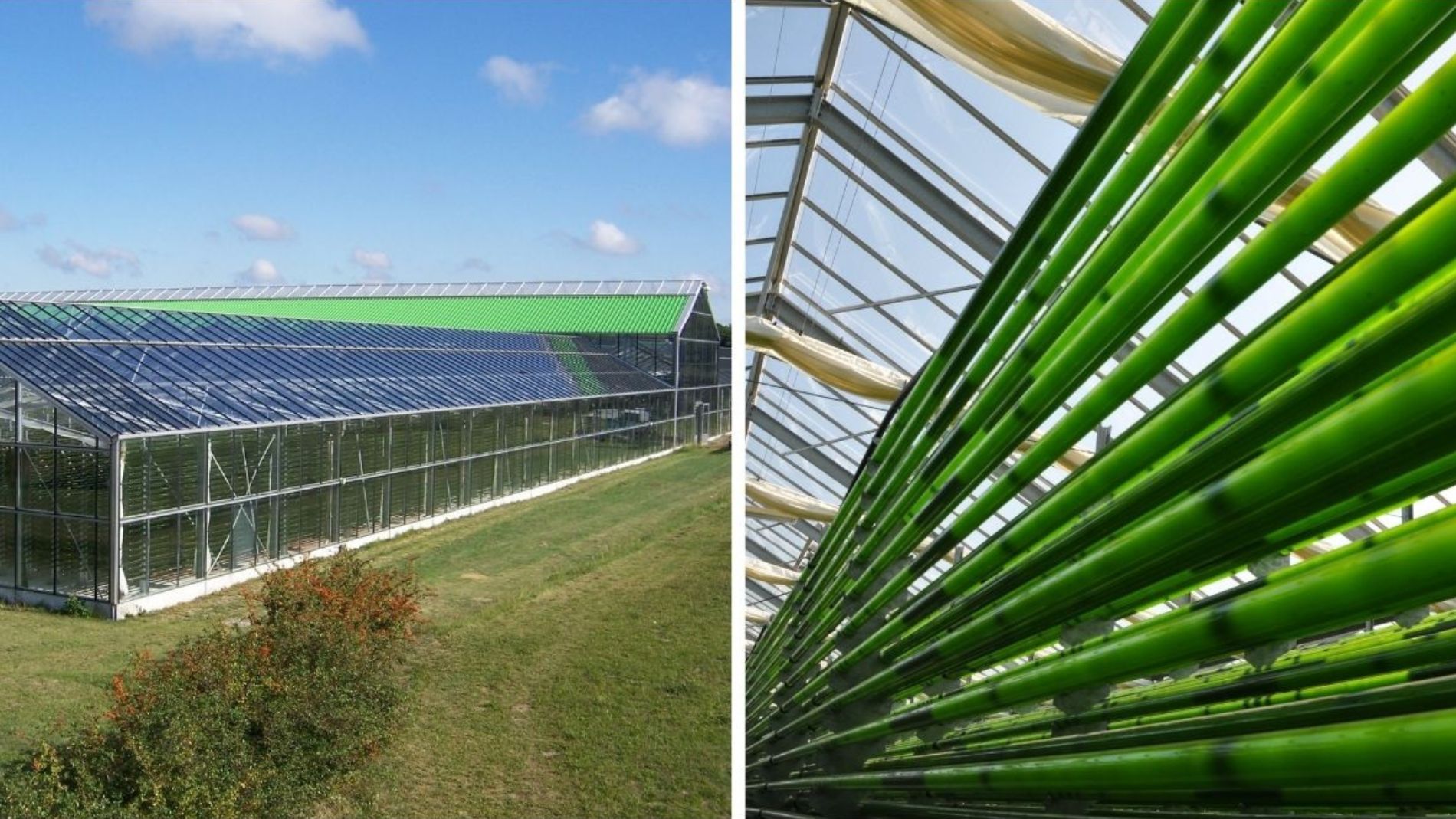
There are three main ways of producing microalgae: open ponds, closed photobioreactors and fermentation in dark tanks. Open ponds are inexpensive but carry a higher risk of contamination. In photobioreactors, the algae grow in a controlled medium, for example in glass or plastic tubes. In fermentation, sugar serves as the energy source.
Worldwide, 97 per cent of brown and red algae (macroalgae) are produced in aquaculture, mainly at sea and in coastal regions⁵. Chlorella is more susceptible to contamination and is therefore usually grown in closed systems, whereas Spirulina can also thrive in open ponds⁵.
Jörg Ullmann, a graduate biologist and managing director of Algenfarm Klötze, sees the choice of process less as a purely technological question than as one of the raw materials available locally. Sugar from regional agriculture can make fermentation possible, but it requires the corresponding land. Light and CO₂, by contrast, allow biomass to be produced at sites unsuited to conventional farming. Nitrogen-rich wastewater from fish farms can also serve as a nutrient source. In his view, integrated systems are therefore particularly interesting³. Production volumes of the individual algae species, however, differ considerably.
The algae market: volumes and companies
According to the Food and Agriculture Organization of the United Nations (FAO), almost 40 million tonnes of algae of all kinds were produced worldwide in 2024. Around 97 per cent of that came from Asia⁸. The detailed figures for 2019 show the scale even more clearly: of 35.8 million tonnes of algae, only around 56,000 tonnes were microalgae, almost exclusively Spirulina. For green microalgae such as Chlorella, only 248 tonnes were recorded: 200 tonnes in China, 42 in Chile and six in France⁸. The statistics cover only aquaculture, so Germany does not appear, even though Chlorella is produced there.
Europe produced 287,386 tonnes in 2019, or 0.80 per cent of the global total. Only 353 tonnes were microalgae; 97.85 per cent of Europe’s total was brown algae⁸. The biggest producers were Norway, France and Ireland, which together accounted for 85 per cent⁵.
The picture is more varied when it comes to companies. Aliga Microalgae, a Danish-Dutch firm, is developing a chlorophyll-free Chlorella with white, neutral-tasting biomass; Allmicroalgae of Portugal and Algenuity of the UK are pursuing similar approaches. The French company Algama uses algae protein as an egg substitute in baked goods and operates a biorefinery in Belgium. Israel’s Brevel combines fermentation with controlled lighting and offers a Chlorella biomass with around 50 per cent protein under the name Purallis⁹. At Corbion in the Netherlands, by contrast, protein is not the focus: in 2023 the company expanded its fermentation-based production of omega-3 fatty acids to 10,000 tonnes a year for aquaculture feed and pet food⁹.
Germany so far produces almost exclusively microalgae. With 14 companies, it ranks second in Europe after Spain⁵. Eleven businesses in northern Germany grow algae for the Deutsche Algen Genossenschaft, the largest association of microalgae producers in Europe. The focus is on Spirulina⁵.
Klötze is home to Germany’s largest closed photobioreactor. Built in 1999, the plant has more than 500 kilometres of glass tubing and mainly produces Chlorella. It employs 19 people. It uses sunlight in greenhouses; production stops over winter and restarts at the end of March¹⁰.
A survey by the German Federal Institute for Risk Assessment (BfR) in autumn 2025 shows how small the market for processed foods containing algae still is: three per cent had eaten meat or meat-substitute products containing algae in the previous year, and six per cent had eaten fish-substitute products¹¹. Quantities alone, however, say little about the potential. What matters just as much is what the biomass contains.
What the raw material contains
The protein content of algae is high but varies considerably. A review by Barka and Blecker gives 55.8 to 77 per cent protein in dry matter for Spirulina and about 7 to 58 per cent for Chlorella, depending on the species⁷. In practice, Jörg Ullmann from Algenfarm Klötze puts the figures at around 60 per cent for Spirulina and 50 per cent for Chlorella. According to Ullmann, soybeans contain about 30 to 35 per cent protein by comparison³. For macroalgae, the Fraunhofer project SeaFeed reports up to 47 per cent protein and annual yields of up to 25 tonnes of dry matter per hectare of cultivated area¹.
The figures are not directly comparable. They depend, among other things, on the measuring method, the origin of the biomass, the nutrient medium, the time of harvest and the production process⁷. For buyers, this means that protein content is a property of the individual batch and not automatically of the algae species as a whole.
Besides protein, algae contain other valuable constituents:
- Carotenoids: natural pigments such as the orange-red β-carotene, a precursor of vitamin A⁷. In Spirulina it contributes to the antioxidant effect².
- Omega-3 fatty acids: depending on the species.
- Pigment protein: Spirulina also supplies a blue pigment protein⁷.
- Vitamin B12: a distinction is needed here. Spirulina contains mainly biologically inactive B12 analogues, known as pseudocobalamins, which the body cannot use. For Chlorella the evidence is less consistent; individual studies point to a higher proportion of bioavailable B12¹².
Whether the raw material is actually usable, however, is decided only in processing.
Also read: “From algae to cell flesh – an overview of alternative proteins“What happens in processing
How much of the protein humans can use depends first of all on whether the cell structure is broken open. Chlorella has a rigid cell wall that must be opened up; in Spirulina the cell envelope is much thinner².
A comparison shows how strongly the process affects protein availability: air-dried Chlorella achieved a net protein utilisation of 31.4, the same biomass after drum drying 68.0. The milk protein casein scored 83.4⁷.
First applications are also emerging in Germany. Algenfarm Klötze developed a bratwurst containing seaweed together with a master butcher from the region¹⁰. Macroalgae are not produced in Germany⁵.
All this makes clear that it is not only technical processing but also safety, raw-material quality and economics that limit use.
Find out how seaweed gives 3D fish alternatives their ‘fishy’ flavour: “Revo Foods Interview“What limits use
The iodine content of dried seaweed can vary widely. Brown algae contain orders of magnitude more than green algae. At EU level, a maximum level of 1 g of iodine per kilogram of dry matter is under discussion. The BfR considers such a limit suitable for reducing individual very high intakes, but not sufficient on its own for regular consumption¹¹. Other substances of concern are cyanotoxins and inorganic arsenic⁶.
Then there is novel food status. Species that were consumed to a significant degree in the EU before 15 May 1997 are not regarded as novel; for other species, authorisation is required⁶˒¹³. For food manufacturers, this means additional requirements for goods-in inspection, specifications and supplier qualification.
Production costs also remain a challenge. According to Jörg Ullmann from Algenfarm Klötze, calculations exist for the plant size at which Spirulina can be produced competitively, and Europe is still far from that point³. There is also a fundamental difference to agriculture: whereas crops have been deliberately bred over generations, algae cultures often still come from wild strains. As a bulk commodity valued purely by the kilogram of protein, algae are currently too expensive. As a functional ingredient with added benefit, however, algae proteins are already on the market: the blue pigment protein from Spirulina, for example, is used in confectionery as an alternative to synthetic colourants³.
The FunSea project runs from 2024 to 2027 and is investigating how brown and green algae can be processed so that they are better suited as food ingredients. Enzymes and microorganisms are to be used to improve both their functional properties and their nutritional value. Partners from Norway, Denmark, Sweden and Germany are involved. SINTEF coordinates the project; the others include Fraunhofer IVV and the manufacturer Bettafish, which uses macroalgae in a fish substitute. The aim is to produce prototypes for the German market⁴.
Economics and conclusion
Whether an algae plant pays its way depends on what is obtained from the biomass. In the FuTuReS joint project, Fraunhofer IGB, the University of Hohenheim and the Karlsruhe Institute of Technology extracted the pigment fucoxanthin, the omega-3 fatty acid EPA and proteins from the diatom Phaeodactylum tricornutum, one after another and following the principle of a biorefinery, all from the same biomass. For the high-priced products, the production effort paid off; extracting protein on top of that no longer improved profitability, because proteins are available worldwide at fairly low prices¹⁴.
Under continuous artificial lighting, the yield of total biomass rose from 14 to 123 tonnes per hectare and production costs per kilogram fell by 70 per cent, albeit with 54 per cent higher electricity demand and markedly lower water and land use¹⁴.
Another route is to dispense with the costly purification of the protein. Here Jörg Ullmann from Algenfarm Klötze cites Saudi Arabia as an example: aquaculture is being expanded there, while feed protein has so far had to be imported. The whole alga is therefore used as feed instead of first laboriously isolating the protein³.
This leaves two assessments side by side:
- The FuTuReS economic analysis describes the current situation, in which cheap proteins make algae production unprofitable.
- Ullmann, managing director of Algenfarm Klötze, is betting on that relationship shifting: conventional proteins are likely to become more expensive, because demand is rising and farming is struggling with climate change, crop failures and scarce land. Algae protein, by contrast, is slowly getting cheaper thanks to larger plants, targeted breeding and more research. ‘Those two curves will cross at some point. The question is just when,’ says Ullmann³. Which assessment proves right remains open.
The sources reviewed are unanimous on what remains unresolved: standardisation of processing, sensory acceptance and a consistent composition of the raw material. For the food industry, algae protein for now remains what it is today: an ingredient used in small quantities, whose value lies less in its protein content than in what else the alga contains.
Header image: Canva
Sources
¹Fraunhofer Institute for Process Engineering and Packaging IVV: ‘Cultivation and utilization of marine macroalgae as food and animal feed ingredients – SeaFeed research project’, accessed 19 August 2026
²Ibrahim, M. E.-D.; Demirel, S.; Yıkmış, S.; Tokatlı Demirok, N.; Ahmed, M. B. O.; Amin, A. K.: ‘Spirulina as a sustainable functional ingredient: nutrient density, bioactives, and food applications’, Frontiers in Nutrition 13:1810841, 2026, DOI 10.3389/fnut.2026.1810841
³Jörg Ullmann, graduate biologist and managing director of Algenfarm Klötze GmbH & Co. KG: interview with the author, 31 August 2026 (in German)
⁴Fraunhofer-Institut für Verfahrenstechnik und Verpackung IVV: „Funktionelle Verarbeitung kultivierter Meeresalgen für innovative Lebensmittelprodukte – Forschungsprojekt FunSea”, (FunSea research project), accessed 29 August 2026 (in German)
⁵Bundesinformationszentrum Landwirtschaft: „Werden Algen auch bei uns erzeugt?”, accessed 31 August 2026 (in German)
⁶Federal Office of Consumer Protection and Food Safety (BVL): accessed 31 August 2026
⁷Barka, A.; Blecker, Ch.: ‘Microalgae as a potential source of single-cell proteins. A review’, Biotechnologie, Agronomie, Société et Environnement 20(3), 2016, pp. 427–436
⁸Food and Agriculture Organization of the United Nations: ‘The State of World Fisheries and Aquaculture 2026’, Rome 2026; detailed figures for 2019 from: Cai, J.; Galli, G.: ‘Global seaweeds and microalgae production, 1950–2019’, WAPI factsheet, FAO, Rome 2021
⁹Company information and trade reports on Corbion, Aliga Microalgae, Algama, Brevel, Allmicroalgae and Algenuity: corbion.com, aliga.dk, algamafoods.com, product information ‘Purallis by Brevel’, allmicroalgae.com, algenuity.com, accessed 31 August 2026
¹⁰Investitions- und Marketinggesellschaft Sachsen-Anhalt mbH: „Die Algenfarm Klötze: eine Erfolgsgeschichte aus der Altmark”, (Algenfarm Klötze: a success story from the Altmark), author: Kathrain Graubaum, investieren-in-sachsen-anhalt.de, accessed 20 August 2026 (in German)
¹¹Federal Institute for Risk Assessment (BfR): ‘Binding Maximum Iodine Levels in Edible Seaweeds May Help Reduce Health‑Relevant Intake Levels, accessed 20 August 2026
¹²van den Oever, S. P.; Mayer, H. K.: ‘Biologically active or just “pseudo”-vitamin B12 as predominant form in algae-based nutritional supplements?’, Journal of Food Composition and Analysis 109, 2022, article 104464, doi.org/10.1016/j.jfca.2022.104464
¹³Regulation (EU) 2015/2283 of the European Parliament and of the Council of 25 November 2015 on novel foods, Official Journal of the European Union L 327, 11 December 2015, accessed 19 October 2026
¹⁴University of Hohenheim, Fraunhofer IGB and Karlsruhe Institute of Technology: Microalgae: possible prospects for agriculture), joint press release on the FuTuReS collaborative project, accessed 20 August 2026