Reading time: 2 minutes
Publication at a glance
Type of publication: Scientific nutrition report
Publisher: German Nutrition Society (Deutsche Gesellschaft für Ernährung, DGE)
Commissioned by: Germany’s Federal Ministry of Food and Agriculture (Bundesministerium für Ernährung und Landwirtschaft, BMEL)
Geographic focus: Germany
Year of publication: 2024
Target audience: Policymakers, researchers, academics and professionals working in nutrition
What is it about?

The 15th Nutrition Report of the German Nutrition Society (DGE) examines the current nutrition situation in Germany against a broader question: how can health, environmental sustainability, social considerations and nutrition be more closely aligned in the future?
Unlike previous editions, the report does not treat sustainability as a standalone topic. Instead, it serves as the overarching framework for the entire publication. The individual chapters therefore assess not only dietary patterns, health data and food offerings, but also the role of food systems in climate protection, resource use, social participation and future nutrition strategies.
The central theme running through the report is the transformation of the food system. Rather than focusing on individual foods, the publication explores which developments are already emerging and where further action is still required.
Why Is the Publication Worth Exploring?
The report brings together a wide range of research projects under a common perspective. Readers gain insights into long-term shifts in food consumption, social inequalities in dietary behaviour, debates surrounding ultra-processed foods and developments in alternative protein sources.
At the same time, the publication highlights topics that often receive less attention in nutrition discussions, including food insecurity, catering in hospitals and care facilities, and the sustainability performance of food service operations.
Rather than presenting only current findings, the report also highlights areas where scientific uncertainty remains and where additional research is considered necessary.
Key Topics
Nutrition at the Intersection of Health and Sustainability
According to the report’s analysis of long-term consumption trends in Germany, several developments are moving in what the authors describe as a more favourable direction. Consumption of certain plant-based foods is increasing, while red meat consumption is declining. At the same time, the report identifies substantial gaps between current consumption patterns and benchmarks assessed from both health and sustainability perspectives.
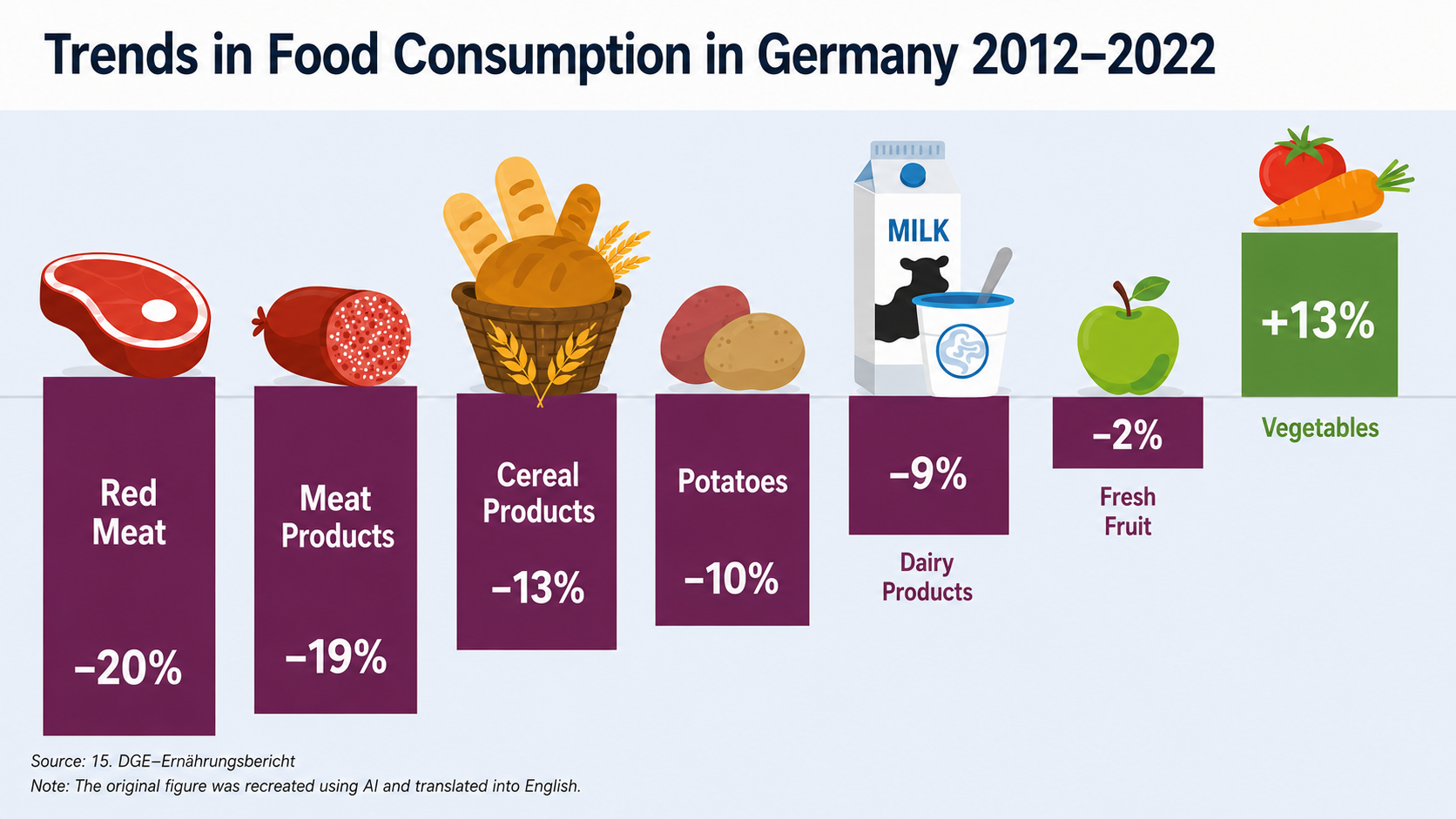
Source: 15. DGE-Ernährungsbericht / The original figure was recreated using AI and translated into English
Social Factors Move Further into Focus
Several chapters underline that nutrition is not solely shaped by individual choices. The studies on households at risk of poverty in particular highlight the importance of financial, social and structural conditions. As a result, food security and the practical feasibility of healthy eating emerge as central themes throughout the report.
Alternative Proteins as Part of a Broader Food-System Debate
For the first time, the DGE Nutrition Report dedicates a separate chapter to alternative protein sources. Plant proteins, fermentation-based approaches, edible insects and cultivated meat are presented in terms of their characteristics, opportunities and challenges. The focus is less on evaluating individual technologies and more on their potential role within future food systems.
Food Service Gains Strategic Importance
Another key area is food consumption outside the home. From hospitals and care facilities to quick-service and chain restaurant concepts, the report examines how these settings can contribute to nutrient provision and sustainability goals. The findings illustrate the significant influence that food environments can have on long-term eating habits.
Read the full report here (available in German only):
* Transparency Notice: The publications featured on Foodtech Now! are selected and curated by the editorial team based on their relevance to the international protein industry. The analysis of the original publication and the preparation of this article were carried out with the support of artificial intelligence. This article is intended as an overview and does not replace reading the full original publication. The original source remains the authoritative reference for all content and statements.