
Reading time: 6 minutes
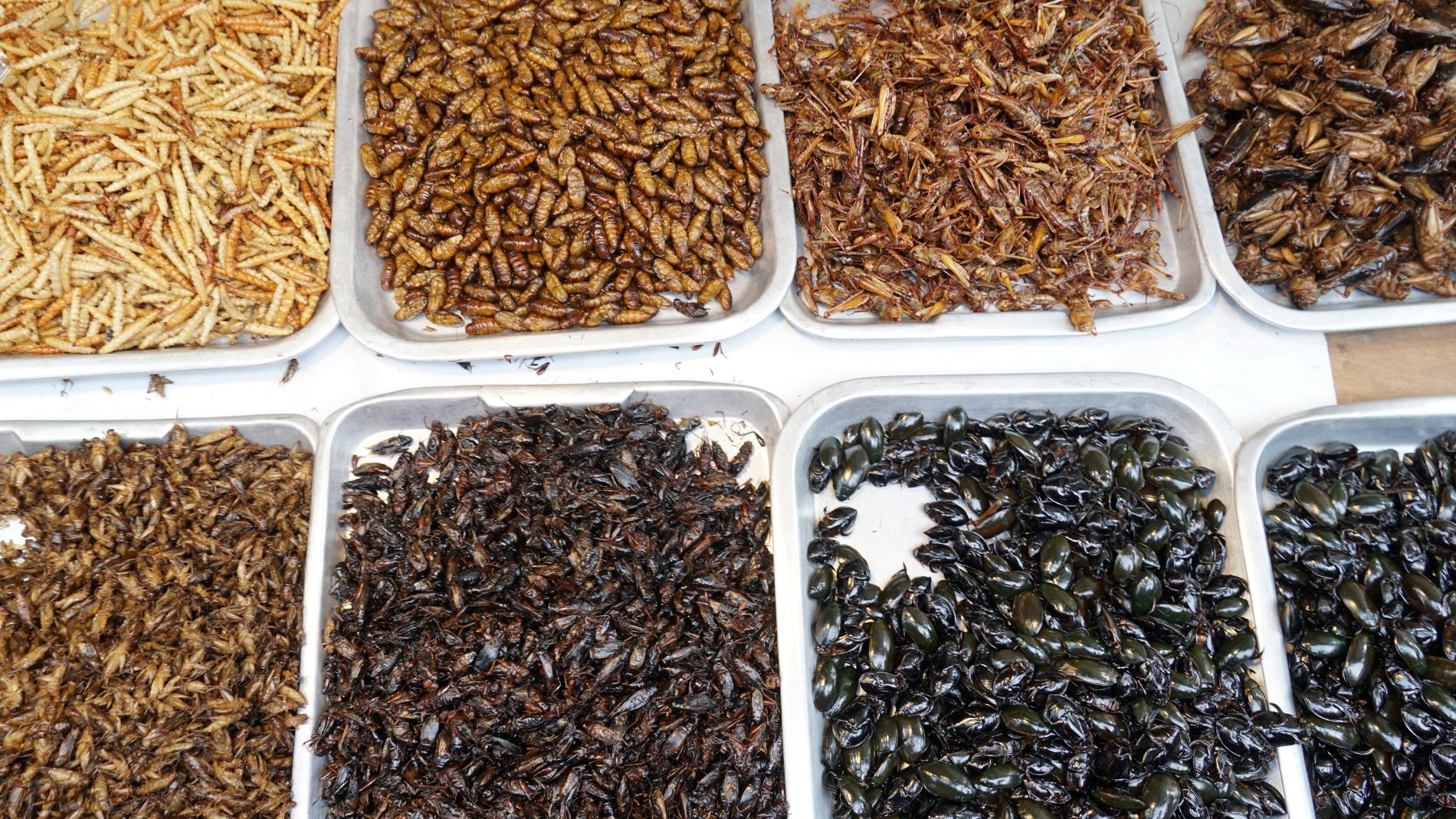
‘We need to get used to the idea of eating insects.’ In his 2010 TED talk, Dutch entomologist Marcel Dicke presented the consumption of insects as crucial to feeding a growing global population sustainably. Expectations steadily rose throughout the 2010s, and by the early 2020s, hopes were high: Start-ups were raising substantial investment funds, governments were supporting research and industry, and market analyses were forecasting growth rates worth billions. The vision was that insects would partially replace fishmeal, soya and even meat in a way that was efficient, resource-effective and climate-friendly.
The industry is currently undergoing a period of restructuring. Prominent companies such as Ÿnsect (France), AgriProtein (South Africa), Beta Hatch (USA) and FarmInsect (Germany) have filed for bankruptcy, while the market for insect protein in pet food is growing steadily.
While the great food revolution has not materialised, the insect protein industry has not failed. Rather, it is evolving into a specialised technology within an increasingly diversified protein market.
A global market with fluctuating trends

Market research firm Mordor Intelligence has estimated the annual volume of the global insect protein market at $308 million for 20251. For comparison, Mordor Intelligence estimates the market for plant-based proteins at $13.05 billion for the same period2. Market studies continue to forecast growth for the insect protein market, particularly in Europe and Asia. However, regional developments vary significantly.
Europe is primarily regarded as a market shaped by regulatory and subsidy policies, in which large-scale production, agricultural and food policies focused on sustainability play a central role. In Asia, insect consumption is a long-standing tradition in some regions, such as Thailand, Laos, Cambodia and south-west China. This means that cultural acceptance is sometimes higher than in Western markets.
North America is developing primarily as a technology- and investment-driven market, particularly in the areas of animal feed and food technology applications3. Although traditional forms of insect consumption exist in some parts of Africa and Latin America4, the industrial production and marketing of insect protein is still in early development or pilot phases in many places.5
From a vision of the future to industrial reality
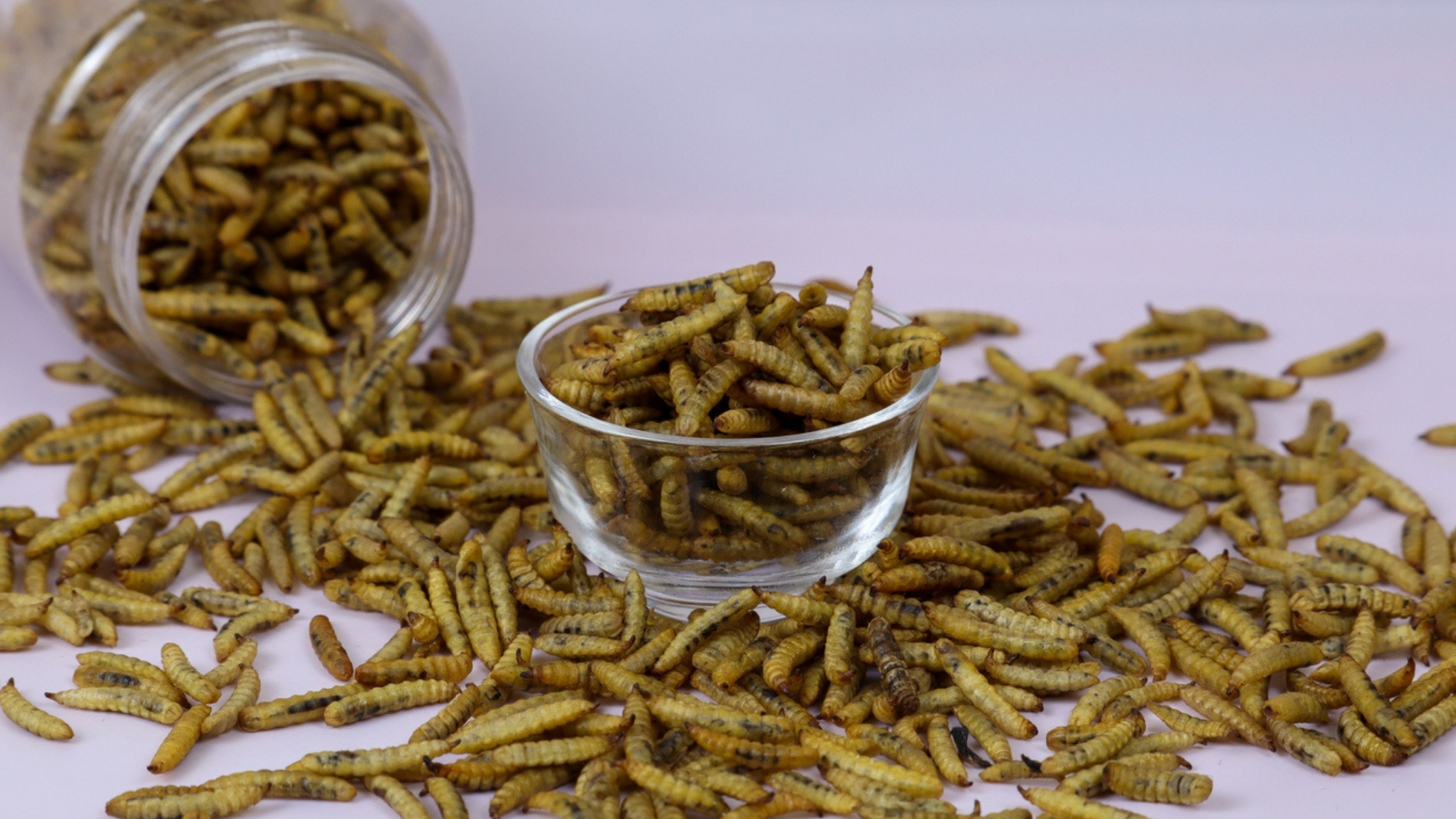
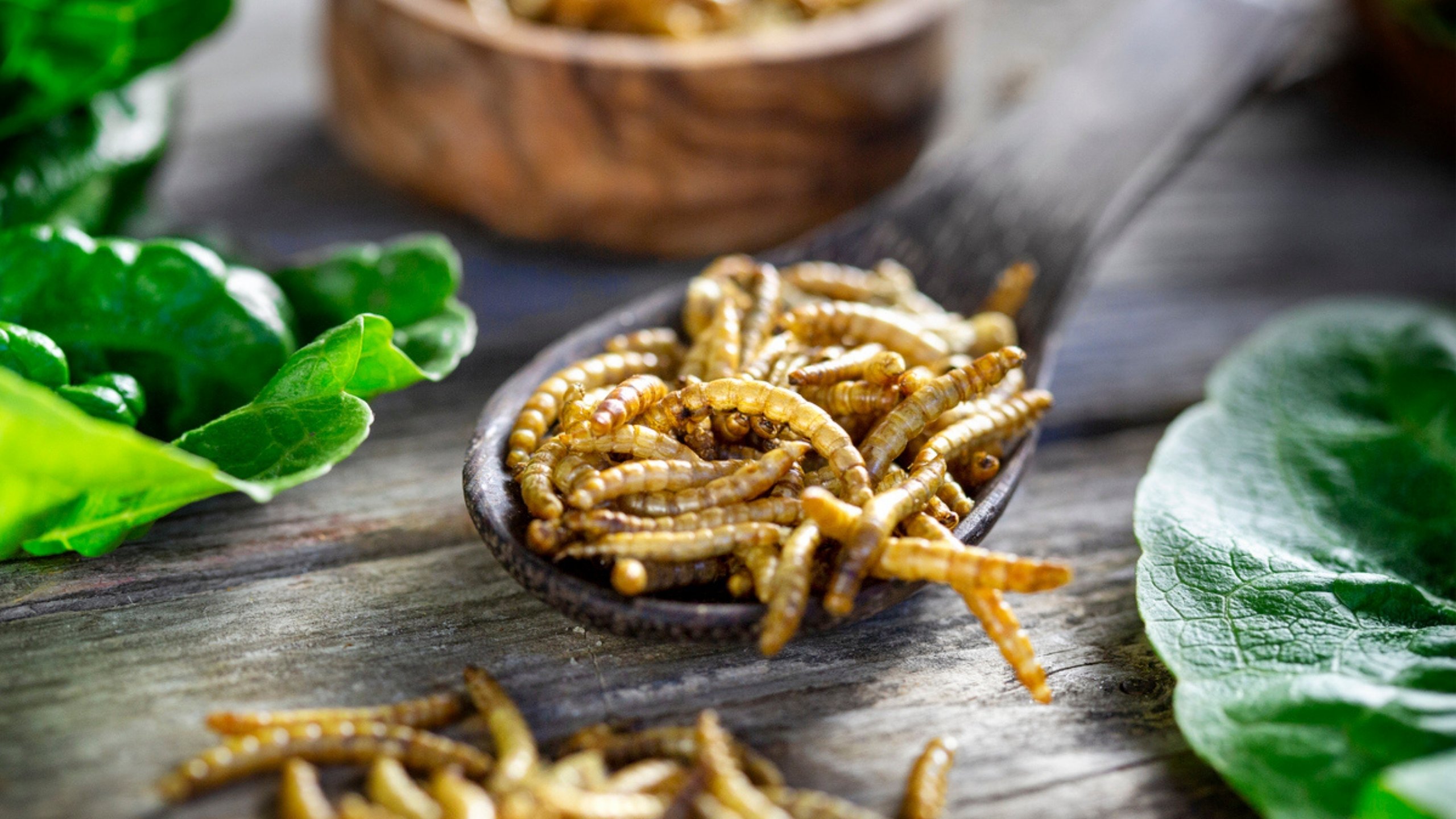
In the early discussions surrounding insect protein, it was believed to have considerable potential as a sustainable source of protein. Supporters of the idea pointed out that insects potentially require less land and water per unit of protein produced than conventional livestock. They grow quickly and can utilise organic waste and by-products. In particular, the black soldier fly and mealworms have emerged as the most significant species in industrial insect farming.
In practice, however, it soon became apparent that achieving cost-effectiveness through scaling up was more complex than initially assumed. Large-scale production facilities require precise climate control, automated cultivation methods and energy-intensive drying and processing procedures. In Europe in particular, this has resulted in high production costs becoming a major competitive challenge.
Added to this, many companies opted for large-scale production models at an early stage, before stable sales markets had emerged. Rising energy prices and tougher financing conditions have further exacerbated the situation.
Human Food: High profile, limited market
Expectations were particularly high in the field of human nutrition. Protein bars, burger patties, pasta, and snacks made from insect-based ingredients were expected to provide sustainable alternatives to conventional protein sources.
However, despite the approval of individual products containing insect protein, consumer acceptance remains limited, particularly in Europe and North America. Studies6 show that many consumers continue to associate consuming insects with disgust. Consequently, labelling such products in the same way as other protein-rich foods does not encourage people to buy them; in fact, it often puts them off. In addition, some consumers are concerned about possible allergic reactions. According to assessments by the European Food Safety Authority (EFSA), cross-reactions to insect proteins may occur, particularly to people with allergies to shellfish or house dust mites7.
In addition to consumer acceptance, regulatory frameworks influence market development. In the European Union, insects and ingredients derived from them are classified as novel foods, requiring authorisation from either the EFSA or the European Commission before they can be placed on the market. While these authorisation procedures provide legal certainty, they can delay the launch of new products8.
In the human food sector, insect proteins are competing with well-established plant-based alternatives. Not only are products based on pea, soya or oat protein more readily accepted by consumers, they also benefit from established supply chains which currently enable more cost-effective production structures than insect protein. Furthermore, plant-based alternatives do not require complex approval procedures as they are ‘established’ foods.
Consequently, investment in the human food sector is developing cautiously. While innovative products and niche markets continue to exist, a breakthrough in the mass market is not yet in sight.
Also interesting for you: Overview insect protein for animal feed and foodAnimal feed: the largest market, high cost pressure

The use of insect protein is currently far more prevalent in the animal feed sector, accounting for the vast majority of its applications. Aquaculture, in particular, has long been considered an ideal target market. Many fish species naturally feed on insects, while the production of fishmeal is under pressure due to overfishing and environmental concerns.
In practice, however, a key problem arises: cost-effectiveness. The production of insect meal is still significantly more expensive than well-established alternatives. According to industry analyses, the cost of a tonne of insect protein can be around 3.5 times higher than that of fishmeal, and around ten times higher than that of soya meal9. This significantly limits scalability, particularly in industrial livestock farming.
Furthermore, recent scientific analyses have cast doubt on certain sustainability claims. For example, the Ricardo LCA Report by DEFRA Science Search10 estimates that insect protein could be up to 13.5 times more harmful to the climate than soya meal, and up to 4.2 times more harmful than fishmeal. The environmental benefit depends heavily on the energy sources used and the feed substrates employed. If energy-intensive processes or high-value agricultural by-products are used, the environmental balance is less clear-cut in some cases than originally assumed.
Nevertheless, the feed market remains one of the most important areas of application for the industry in the medium term, albeit presumably more as a supplement and speciality ingredient than as a complete replacement for traditional protein sources.
Pet food is emerging as the most stable segment

The pet food market is currently experiencing the most stable growth. In this sector, insect protein is primarily positioned as a premium, hypoallergenic and sustainable ingredient. Unlike traditional livestock farming, consumers in the pet food sector are willing to pay significantly higher prices for products that promise health or functional benefits.
Several manufacturers have now launched their own ranges of insect-based food for dogs and cats. These can now be found not only in Europe, but in other markets too. For instance, the pet food brand Cosmopet launched a complete range of dry food containing insect proteins for dogs and cats in the United Arab Emirates in early 2026, with 10–20 per cent of the total protein content coming from insects.
The ‘disgust factor’, which plays a significant role in the human food sector, is largely absent here. At the same time, hypoallergenic recipes provide concrete functional benefits that can justify higher prices.
A specialised approach rather than a one-size-fits-all solution
At the same time, the industry’s structure is changing. Rather than serving as a general substitute for traditional proteins, insect protein is increasingly finding its place in specialised market segments.
Its primary applications include use as functional ingredients in the food and feed industries, in specialised pet food, and in aquaculture and livestock feed. There is also growing use of insect lipids and oils, particularly in animal nutrition. In certain niche markets, fertilisers based on insect biomass are also being developed.
In addition, by-products are generated during processing that can be used in independent industrial applications. Notably, these include chitin and chitosan, which are derived from insect exoskeletons and used in fields such as materials science, agriculture, cosmetics, and medical applications.
This shift is reflected in the strategic direction of companies such as Beta Bugs, which are increasingly focusing on breeding optimisation and specialised industrial applications rather than building up large-scale production capacities. Rather than focusing solely on building up large-scale production capacities, firms such as Beta Bugs are increasingly focusing on breeding optimisation and specialised industrial applications.
Conclusion: The industry is undergoing a restructuring
The development of the insect protein market shows how visions of a technological future can clash with industrial reality. The initial expectation that insect protein would become a widely accepted alternative protein source has not yet been realised.
At the same time, however, a more nuanced and economically realistic picture of the sector is emerging. In sectors such as premium pet food, specialised animal feed and technical and agricultural applications outside the food chain, insect protein continues to demonstrate its potential.
Thus, the market is evolving less as a universal solution to global food problems and more as a specialised technology within the broader protein and circular economy markets.
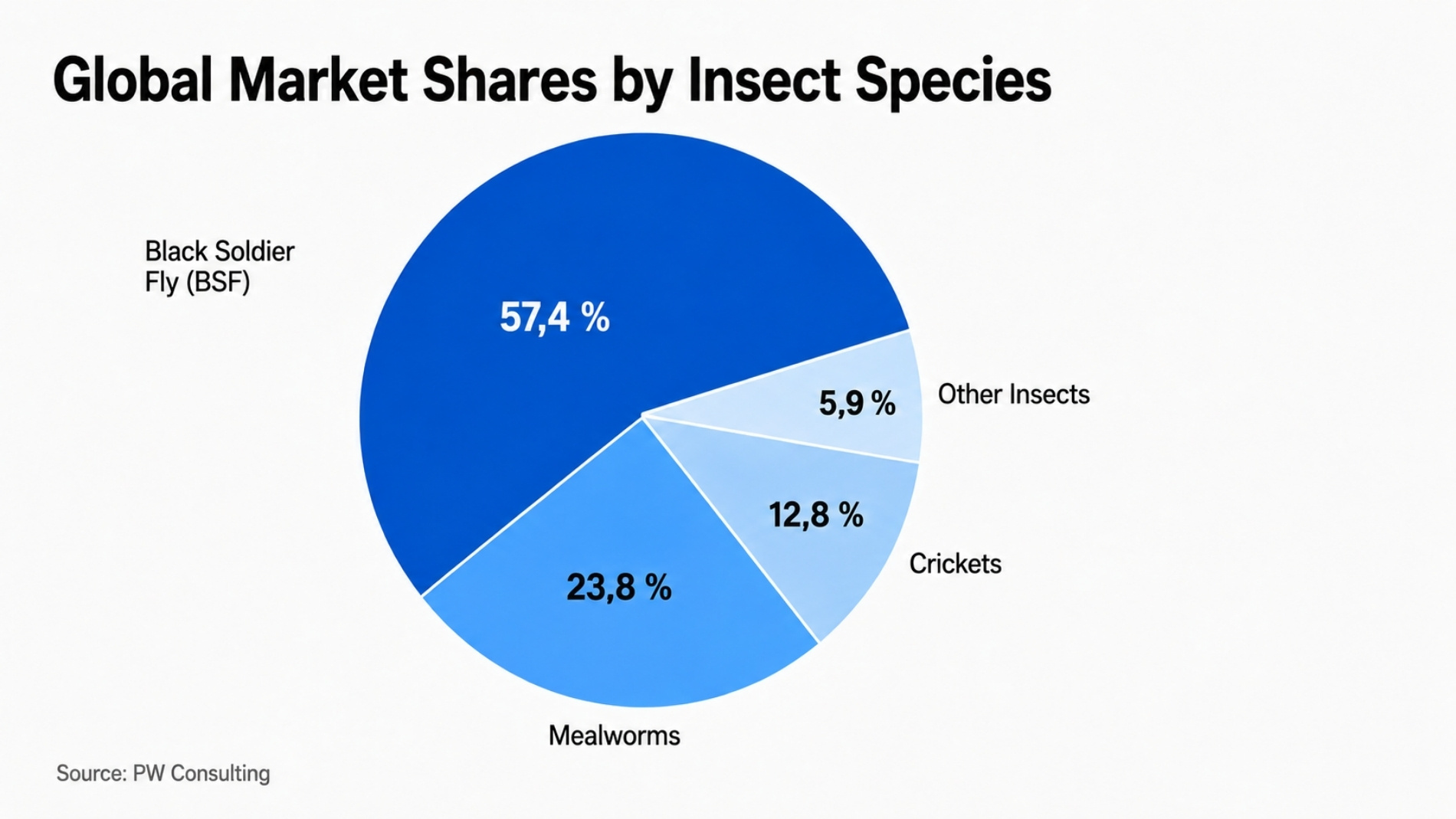
The global insect protein market is currently dominated by a few species that are of industrial relevance. In animal feed production, the black soldier fly plays a central role, while crickets are used primarily in human food production. Mealworms are a versatile species used in both food and feed applications. According to PW Consulting, these market shares refer to the total market for insects as ingredients in animal feed, pet food, food and beverages, and other uses in 2025.11
Sources
1 Insect Protein Market Size, Share & 2031 Growth Report 02.06.2026.
2 Plant Protein Market Size & Share Outlook to 2031 02.06.2026.
3 Edible Insects Market Size, Share, Industry Forecast, 2034 02.06.2026.
4 A Review on the Current Research and Industrialization Status of Edible Insect Protein - PMC 02.06.2026.
5 Frontiers | Toward a regional regulatory framework for edible insects in Latin America: opportunities and challenges 02.06.2026.
6 BRS - Kaum Marktchancen für Lebensmittel auf Insektenbasis (in German language) 01.06.2026.
7 Safety of dried yellow mealworm (Tenebrio molitor larva) as a novel food pursuant to Regulation (EU) 2015/2283 - - 2021 - EFSA Journal - Wiley Online Library 02.06.2026.
8 Insektenprotein: Nachhaltige Proteinquelle der Zukunft (in German language) 02.06.2026.
9 Insect-based livestock feeds are unlikely to become economically viable in the near future 12.05.2026.
10 UK Government-commissioned Life Cycle Assessment (LCA) challenges the sustainability of insect feed — The Insect Institute 02.06.2026.
11 Worldwide Insect Ingredient Market 2026 - PW Consulting 02.06.2026.
Header image: SolStock